


On May 7, 2026, Google quietly stopped showing FAQ rich results in Search. No press event. No countdown. The expandable Q&A accordion that millions of pages had spent years optimizing for just stopped appearing on the SERP. Most teams won’t even notice until next month, when the impressions for that search appearance go to zero in Search Console and somebody asks why.
This is the right time to look up from your dashboards. Because the FAQ change is the smaller story. The bigger story is that the SEO playbook every marketer was taught between 2015 and 2023 (optimize the page, win the snippet, capture the click) has been quietly dismantled. Sixty percent of all Google searches now end with zero clicks. Click-through rates on pages with AI Overviews above them have collapsed from 1.76 percent to 0.61 percent. The overlap between top-ten Google rankings and AI Overview citations has dropped from 75 percent in mid-2025 to as low as 17 percent today. Rich snippets are being retired one by one. The SERP marketers spent a decade learning is the SERP that no longer exists.
Here’s what changed, what it means, and what to do about it.
What Google actually did with FAQ rich results
The FAQ deprecation wasn’t a one-day event. It was a three-year retirement that finally completed last week.
- August 8, 2023. Google’s first move. The company announced that FAQ rich results would only show for “well-known, authoritative government and health websites” going forward. HowTo rich results were limited to desktop. The reason: schema abuse. Sites had been bolting fake FAQ sections onto every page to inflate SERP real estate.
- 2024–2025. HowTo rich results were phased out completely on both desktop and mobile.
- March 12, 2026. Google’s March 2026 core update completed and FAQ rich result impressions dropped by nearly half across tracked sites within days.
- May 7, 2026. FAQ rich results stopped appearing in Search entirely.
- June 2026. Google will remove the FAQ search appearance and the rich result report from Search Console, and drop FAQ support from the Rich Results Test.
- August 2026. FAQ rich result support will be removed from the Search Console API.
The schema itself isn’t banned. Google has been clear that you can keep FAQPage markup on your site. They’ll still parse it to understand the page’s content, and they won’t penalize you for having structured data they don’t render. You just won’t see the expandable accordion anymore. Neither will your users.
FAQ wasn’t the only schema retired
The FAQ kill is part of a broader 2025–2026 cleanup. Google has retired seven additional rich result types on top of FAQ and HowTo:
| Retired feature | What it used to do |
|---|---|
| Book Actions | Buy / preview buttons in book listings |
| Course Info | Course detail panels under educational queries |
| ClaimReview | Fact-check verification labels |
| Estimated Salary | Compensation data inside job listings |
| Learning Video | Enriched video learning panels |
| Special Announcement | Time-sensitive alerts (introduced for COVID-19) |
| Vehicle Listing | Auto inventory cards with specs and CTAs |
Pattern recognition is the point. Anything added during the 2018–2022 “fill the SERP with rich features” era that got widely abused has been quietly walked back. Google’s stated reason is “a cleaner, more consistent search experience.” The unstated reason is that AI Overviews now occupy the screen real estate rich results used to fill.
The bigger story: the 2026 SEO reset
If you only read the FAQ headline, you’ll misread the moment. The data underneath is what should change your roadmap.
Zero-click is now the default
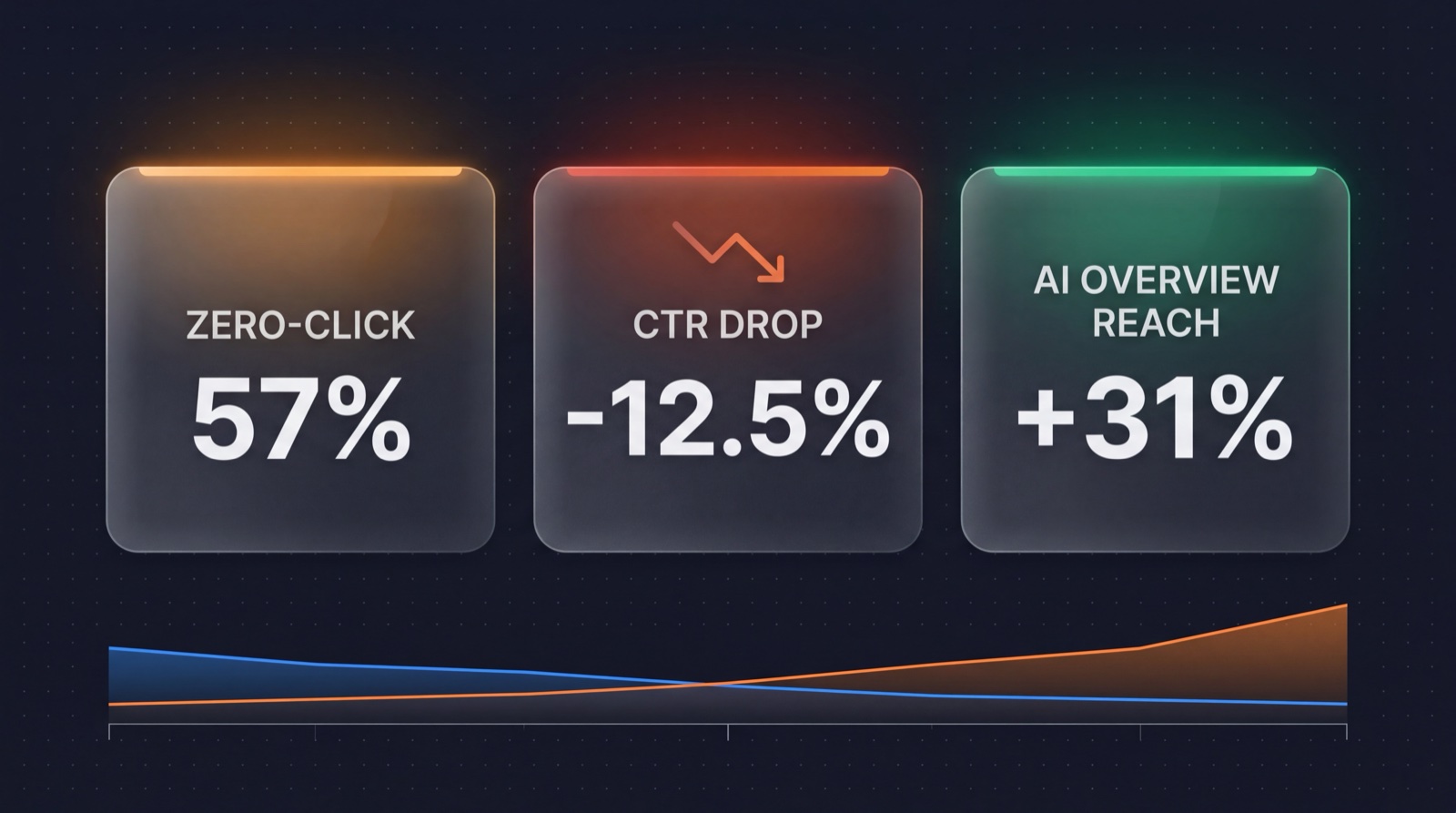
60 percent of all Google searches end without a single click. On mobile, that figure is 77 percent. For queries that trigger an AI Overview, the zero-click rate climbs to roughly 80 percent. The user gets the answer. The publisher gets nothing. Nobody clicks. This is structural, not a Google A/B test that will reverse next quarter.
Organic CTR has collapsed where AI Overviews appear
When an AI Overview shows above the organic results, the average CTR for the top blue link drops to 0.61 percent. That’s down from 1.76 percent in mid-2024, a 61 percent decline. On queries without AI Overviews, CTR also fell, from 2.74 percent to 1.62 percent, but more gently. The penalty for being below an AI Overview is now larger than the penalty for being on page two.
AI Overview coverage is doubling, not plateauing
AI Overview appearance rates have grown from 6.49 percent of queries to 13.14 percent in twelve months, with category-level reach at 32.76 percent. Real estate queries saw 258 percent growth in AI Overview presence year over year. Restaurant queries 273 percent. Retail 206 percent. This isn’t converging on a steady state. It’s still climbing.
Top-10 ranking no longer guarantees AI Overview citation
This is the most important data point most marketing teams haven’t internalized yet. The overlap between the top ten organic Google results and the URLs cited inside AI Overviews has collapsed from 75 percent in mid-2025 to between 17 and 38 percent in early 2026. Translation: ranking on page one is no longer the same project as being cited by AI. They’ve become two different optimization problems with different inputs.
The traffic distribution has gone bimodal
Aggregate U.S. organic search traffic is only down about 2.5 percent year over year. But that average hides a violent split:
- Top 10 sites (the largest brands): grew about 1.6 percent.
- Sites ranked 100 to 10,000 in their categories: saw the sharpest declines.
- Median publisher: down roughly 10 percent annually.
Specific case studies make the split tangible. HubSpot is down 70 to 80 percent. People.com is up 27 percent. Men’s Journal is up 415 percent. The story isn’t “AI is killing organic traffic.” It’s “AI is consolidating organic traffic to sites it considers authoritative, and the bar to qualify just went up.”
Why this is happening (the reading you need to do this once)
Three forces compounded.
Schema abuse forced Google’s hand. FAQ, HowTo, and most of the retired schemas got widely gamed. When 60 percent of pages in a category have FAQ markup that doesn’t reflect real user questions, the rich result stops being useful and starts being a SERP weed. Killing the rich result is cheaper than building better detection.
AI Overviews are the new SERP feature. Every retired rich result freed up vertical pixels that Google now uses for the AI Overview, the People Also Ask carousel, and the shopping panel. The SERP is being recomposed around AI summarization, not around individual organic results.
The CTR economics have inverted. When the AI Overview answers the question, the organic links underneath become a “see sources” footer. Rankings still matter for being cited inside the AI Overview, but the click that used to come from being ranked is now mostly absorbed by the AI itself.
What still works in 2026
Three things are clearly winning. None of them are “publish more content.”
Citations beat rankings
Brands cited inside AI Overviews see 35 percent higher organic CTR and 91 percent higher paid CTR on the same query. Citation is the new “above the fold.” The optimization target moves from “rank #1 for X” to “be the source the AI Overview pulls when somebody asks about X.”
Structured, AI-parseable content
Even though the FAQ rich result is gone, AI search engines like ChatGPT, Perplexity, Gemini, and Google AI Overviews still parse FAQ schema as a primary signal when extracting Q&A answers. The schema lost its visible reward but kept its invisible one. Comparison pages that contain three or more tables earn 25.7 percent more citations from ChatGPT than pages without them. Lists, definitional first paragraphs, and clean headings make the difference.
Brand and authority signals
Top-10 brand sites grew while everyone else fell because AI systems prefer entities they can verify. That means consistent NAP data, real reviews, real backlinks from real publications, and a clean entity graph (Wikipedia, Wikidata, LinkedIn, Crunchbase, and industry directories all saying the same thing about you). The Local Entity Model we wrote about in January describes this in more detail and hasn’t aged a day.
What to actually do this quarter
If you operate a content site or run SEO for one, here’s the punch list for Q2/Q3 2026.
- Don’t rip out your FAQ schema. Google still uses it to understand your pages, and AI search engines still parse it. Removing it is busywork that risks losing AI citations. Leave it.
- Stop adding fake FAQ sections. Anything bolted on for SERP real estate is now zero ROI and pollutes the page. Delete the FAQ blocks that don’t reflect real questions your customers ask.
- Reorient KPIs from rank to citation. Add AI Overview citation tracking and ChatGPT/Perplexity citation tracking to your SEO reporting. If your tool stack doesn’t support it, that’s now a tool-stack problem.
- Front-load every article with a 50 to 70 word answer summary. AI models lift the first clean answer they can find. Long preambles get skipped. Lead with the answer, then structure the rest as elaboration.
- Build comparison and how-to content with tables. Tables, structured lists, and labeled sections are disproportionately cited by AI systems. Every category-defining page should have at least one comparison table.
- Audit your entity graph. If your brand is described differently across Wikipedia, LinkedIn, Crunchbase, your own About page, and Google’s Knowledge Graph, AI systems struggle to verify you and skip you. One canonical description, one set of facts, propagated everywhere.
- Diversify the channel mix. If 60 percent of searches end without clicks and the AI Overview is taking the rest, content distribution beyond Google search becomes mandatory. Email, paid social, LinkedIn, YouTube, Reddit, and AI ad surfaces like OpenAI Ads are not optional channels in 2026.
The bottom line
Killing the FAQ rich snippet is what people will write headlines about, but the FAQ snippet was a 2018 feature. The story underneath it is a structural reset. Zero-click is now the default user behavior. AI Overviews have decoupled organic ranking from organic visibility. And the SERP is being rebuilt around AI summarization rather than around blue links.
Marketers who treat 2026 as a “make our SEO better” project will lose ground every quarter. Marketers who treat it as a strategic shift, from ranking to citation, from page optimization to entity authority, from search-only distribution to a real channel mix, will pull away from their competitors during the messy middle and own their categories on the other side.
If you want help auditing where you stand on AI citations versus traditional rankings, rebuilding your entity graph, or rewriting category content for the new SERP, that’s exactly what the SEO team at MaaS by CodeSM does for clients every day. Get in touch and we’ll benchmark your category and map the work.
Share this article