
For most of ChatGPT’s life, OpenAI kept saying ads weren’t on the roadmap. That changed slowly through 2025 and then broke wide open in 2026. ChatGPT Ads are now live. There’s a self-serve Ads Manager. There’s CPC bidding. There’s a pixel and a Conversions API. There are named adtech partners and a leadership hire whose entire job is to monetize the consumer side of the product.
If you sell anything to anyone, ChatGPT Ads is the most important new ad channel since TikTok. Almost no marketer has hands-on reps yet, which means the smartest move you can make in Q2 and Q3 is to go from “I’ve heard about this” to “I have a campaign live.” This guide is built to get you there.
What ChatGPT Ads actually is
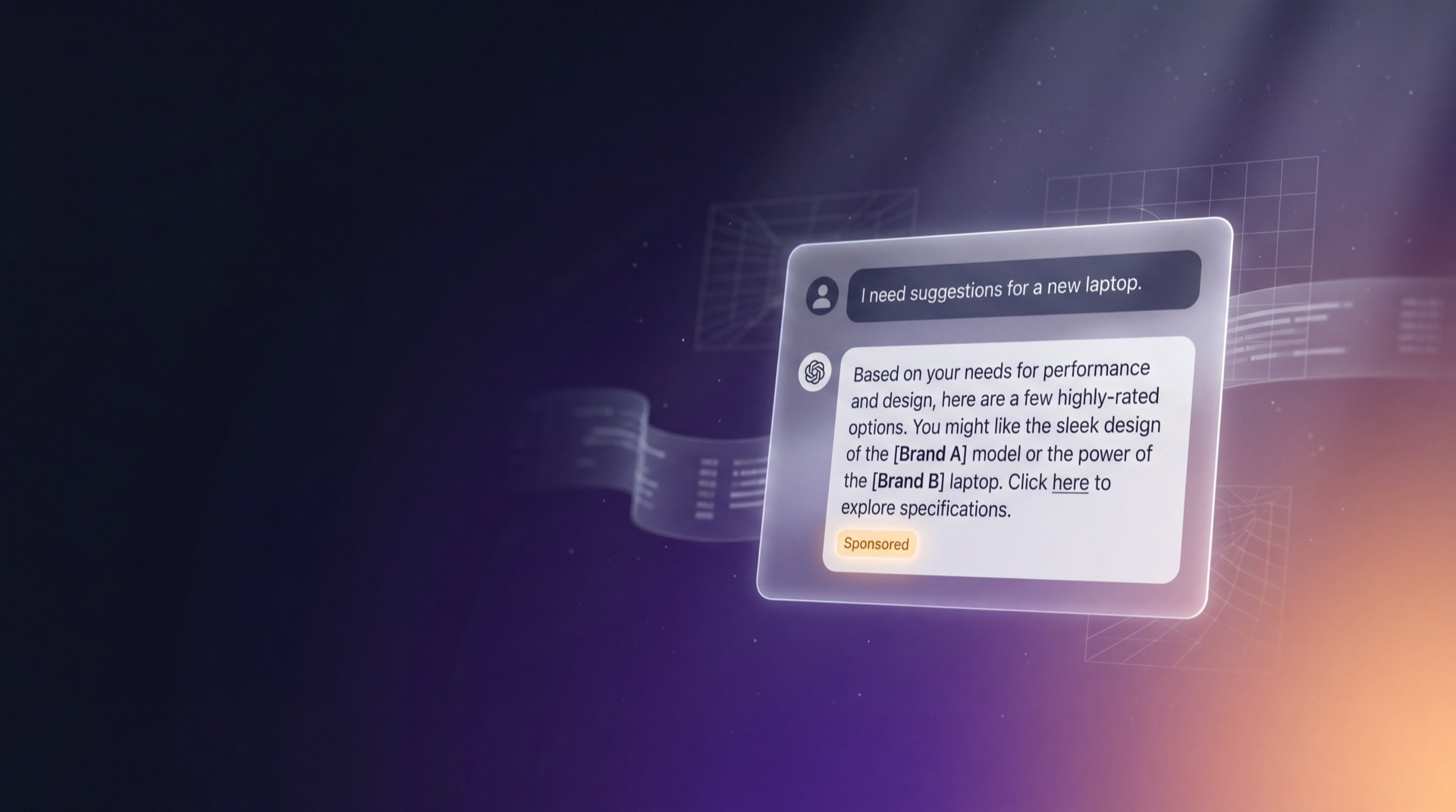
ChatGPT Ads (officially branded by OpenAI as “ads in ChatGPT” or “OpenAI Ads”) is a paid placement system that runs inside ChatGPT’s Free and Go consumer experiences in the United States. When a user has a conversation with commercial intent, like researching a CRM, comparing running shoes, or planning a trip, ChatGPT can surface a clearly labeled sponsored recommendation alongside its organic answer. Pro, Business, Enterprise, and Edu accounts do not see ads.
OpenAI began testing inside the U.S. for logged-in adult users on Free and Go plans in late 2025 and confirmed the move publicly on January 16, 2026. The next four months were a steady drumbeat of platform maturity:
- February 2026. Personalized ads turn on by default for users with memory enabled.
- April 21, 2026. Cost-per-click bidding goes live alongside the existing CPM model.
- April 30, 2026. OpenAI’s U.S. privacy policy is updated to formalize the sharing of certain user data with outside marketing partners.
- May 2026. The self-serve Ads Manager opens in beta to all U.S. advertisers, with new ecosystem partnerships announced including Pacvue, Kargo, and StackAdapt, plus tech integrations with Criteo and Adobe and agency partners WPP and Publicis Groupe.
OpenAI is targeting roughly $2.5 billion in ChatGPT Ads revenue in 2026 and a long-term goal of $100 billion by 2030. Annualized ad revenue is reported to have already crossed $100 million. That isn’t “experiment” money. That’s “this is now a core revenue line” money.
Why OpenAI is doing this (and why it matters for the ChatGPT Ads auction)
A few things are driving it. First, OpenAI burned roughly $8 billion in cash in 2025. Compute costs for frontier models aren’t coming down fast enough to justify a free consumer product without subsidization. Ads are the only realistic way to keep a free tier alive at the scale ChatGPT now operates at. Second, Fidji Simo (formerly CEO of Instacart, now OpenAI’s CEO of Applications) was hired specifically to build the consumer business and the monetization layer on top of it. Third, ads are an inventory game. The more weekly active users ChatGPT has, the more attractive the auction becomes, and ChatGPT is one of the largest consumer products on earth.
The takeaway for marketers: this isn’t a tentative pilot. The flywheel is running. Bids you place over the next two quarters are going to set early benchmarks, and the platform is hungry for performance advertisers. CPMs at launch were quoted in the $60 range and have already drifted down toward $25 as inventory expanded, which is exactly why CPC bidding launched in April. OpenAI knows performance buyers won’t stay on a CPM-only product, and the recommended starting CPC range right now sits around $3 to $5 per click.
How ChatGPT Ads work — the mechanics
Where ChatGPT Ads appear (placement)
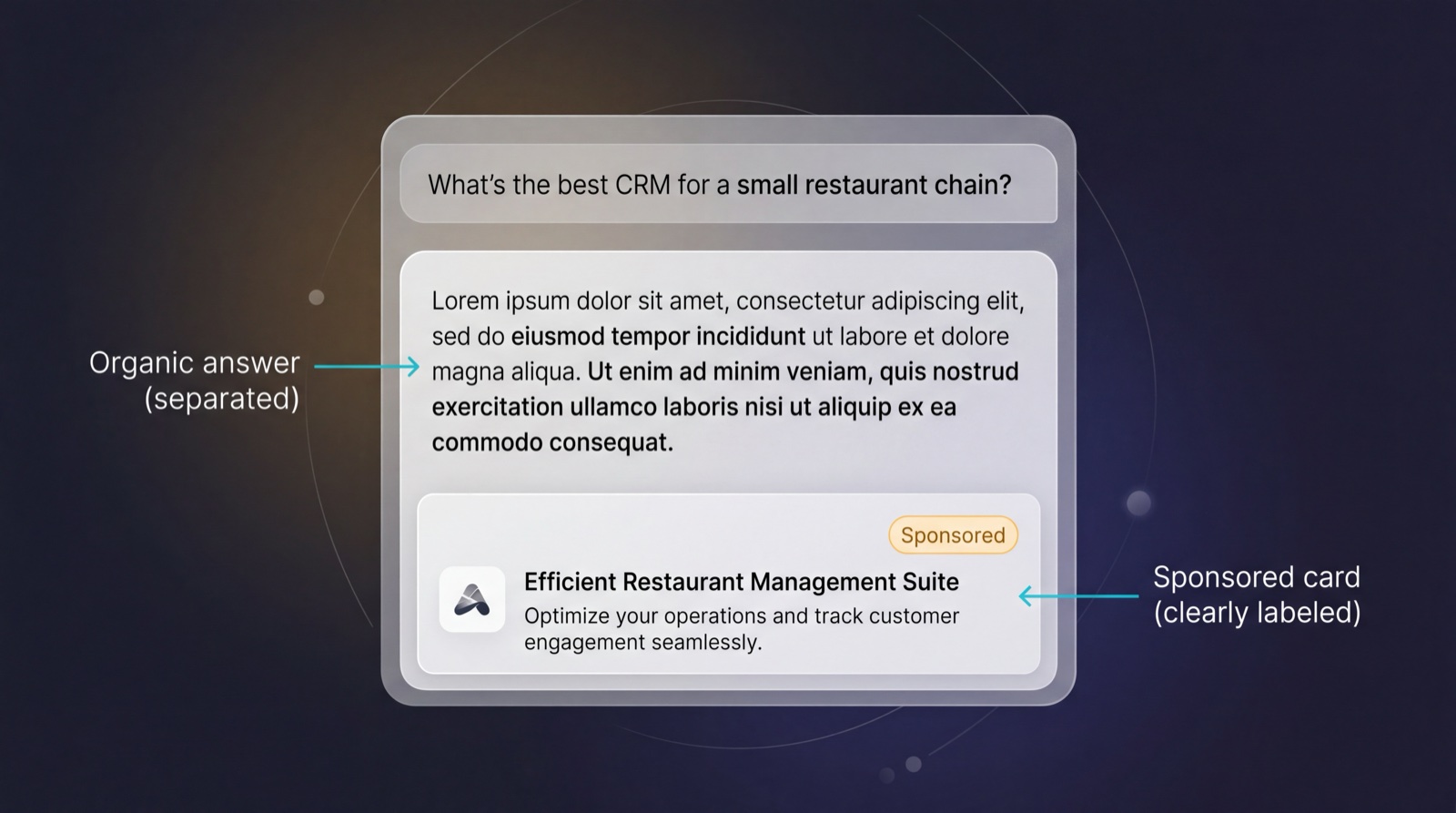
Ads appear at the bottom of a ChatGPT response when the conversation has commercial intent and a relevant product or service is available. They’re visually separated from the organic answer and clearly labeled as sponsored. They cannot interrupt mid-answer, cannot rewrite the model’s response, and cannot appear at all inside conversations on restricted topics. Health, mental health, and politics are explicitly fenced off.
There are three creative formats live or in testing today:
- SearchGPT placements. Sponsored cards in the AI-synthesized answer surface that ChatGPT now uses for shopping and research-style queries.
- Conversational thread ads. Sponsored cards inside standard chats when commercial intent is detected.
- Visual ad cards. A logo, a 40-character headline, a 150-character descriptive line, and a destination URL or install button.
How ChatGPT Ads targeting works
This is the part most marketers get wrong on first read. ChatGPT Ads is not a Meta-style behavioral targeting product. It’s closer to Google than to Facebook, which is exactly how Fidji Simo has been describing it: an intent-based system, not a profile-based one. The auction matches an ad to a conversation primarily on three axes:
- Topic of the current conversation
- Past chats (only if memory is enabled by the user)
- Past interactions with ads in ChatGPT
So contextual intent (what the person is asking right now) is the dominant signal. Behavioral targeting layers on top via the personalization toggle, but the conversation itself does most of the work. If you’ve ever bought paid search, you already understand 70 percent of how to win in this auction.
Auction
Under the hood it’s a relevance-weighted second-price auction. Advertisers pick an objective (Reach priced on CPM, or Clicks priced on CPC), set a maximum bid, and let the system match against eligible conversations. As of April, OpenAI’s recommended starting CPC bid is $3 to $5. Treat that as a floor for testing, not a target.
Measurement
The April–May 2026 update introduced two essentials performance marketers were waiting for: a pixel for site-side event tracking, and a Conversions API for server-side measurement of purchases, signups, and leads. Reporting back to advertisers is fully aggregated. OpenAI does not share individual conversations, memories, chat histories, or personal details. You see views, clicks, and conversions. You don’t see who said what to ChatGPT.
Privacy
This is the line worth memorizing if you’re pitching this internally: ads run on systems that are physically separate from the model that generates ChatGPT’s answers. The model itself doesn’t “know” there’s an ad in the thread unless the user explicitly asks about it. That separation is the only thing making the product viable. If users decided ads were biasing answers, the channel collapses. OpenAI knows it, which is why they’ve been so loud about the firewall.
How to run ChatGPT Ads (step-by-step)
If you’re reading this in mid-2026, you can run real ChatGPT Ads campaigns today. Here’s the practical sequence.
1. Pick your route in
You have three ways to buy:
- Self-serve Ads Manager (beta, U.S. advertisers). Sign in, set up a billing account, build a campaign, launch.
- Adtech platforms. Pacvue, Kargo, and StackAdapt have native integrations and are useful if you already buy on retail media or programmatic stacks. Criteo and Adobe Advertising Cloud round out the pipes.
- Agency partners. WPP and Publicis have early access programs. If you spend at the holding-company level, your team is likely already in conversations.
For most mid-market brands, the self-serve manager is the right starting point. The platform isn’t yet so saturated that you need an outside operator to find inventory.
2. Pick your objective
Run Clicks (CPC) if you want users to land on your site, fill out a form, or start a purchase. Run Reach (CPM) only if you have a true awareness mandate and creative built for an introduction, not a conversion.
Almost everyone reading this should default to CPC.
3. Build creative for the ChatGPT Ads format
ChatGPT Ads creative is tight. Forty characters in the headline. One hundred fifty in the body. Treat it like Google Responsive Search Ads with a stricter character budget. The headlines that win are specific, outcome-oriented, and avoid the “we are the best” trap:
- Weak: “Premium running shoes for everyone”
- Strong: “Marathon-grade shoes returnable for 90 days”
Lead with the specific decision the user is trying to make. The auction is contextual, so your headline should answer the next question in the conversation, not introduce your brand from scratch.
4. Install the pixel and Conversions API
Don’t skip this step. The pixel gives you site-side intent signals. The Conversions API gives you server-side measurement that survives browser privacy changes. Together they’re how you prove ROI to your CFO and how the auction’s ML learns who is valuable for your brand. Marketers running ChatGPT ads without the Conversions API are flying blind and overpaying.
5. Set bids correctly
Start at OpenAI’s recommended $3 to $5 CPC range, then look at three things after seven to ten days:
- Click-through rate. Under 2% in commercial categories means your headline isn’t matching the conversation.
- Conversion rate. Compare to your paid-search benchmark. ChatGPT traffic tends to convert at search-quality levels because intent is high.
- CPA. Your primary success metric. If CPA is below your blended target, raise bids and expand inventory before competitors do.
6. Stay out of restricted lanes
OpenAI’s policy is strict on health, mental health, and politics. If you operate in regulated categories like medspa, supplements, financial services, telehealth, or anything political, you need to read the ad policies carefully before assuming you can run. Even where you can, the brand-safety bar is high.
7. Plan for personalization (and the privacy debate)
The April privacy policy update means more user signal flows to the auction over time. That’s good for performance, but it’s also the area regulators and users are watching most closely. Build creative that performs on contextual intent alone, so a future tightening of personalization rules doesn’t destroy your campaign overnight.
How ChatGPT Ads is different from Meta and Google Ads
Three differences matter most.
Meta is a profile auction. OpenAI is a conversation auction. Meta knows who you are. OpenAI knows what you’re trying to do right now. That makes ChatGPT closer to Google search than to a social feed.
Google is keyword-priced. OpenAI is intent-priced. There is no keyword bid sheet. You’re not buying “best CRM for restaurants.” You’re buying eligibility to appear in conversations where ChatGPT has determined commercial intent for a CRM. Your creative and your conversion signal teach the auction what you want.
Meta and Google have a decade of measurement. OpenAI has months. Treat early benchmarks as directional. Build a clean test design, hold a portion of budget back as a comparison cell, and revisit your CPA targets monthly. The platform will mature fast and what’s true today will be wrong by Q1 2027.
What about the competitors?
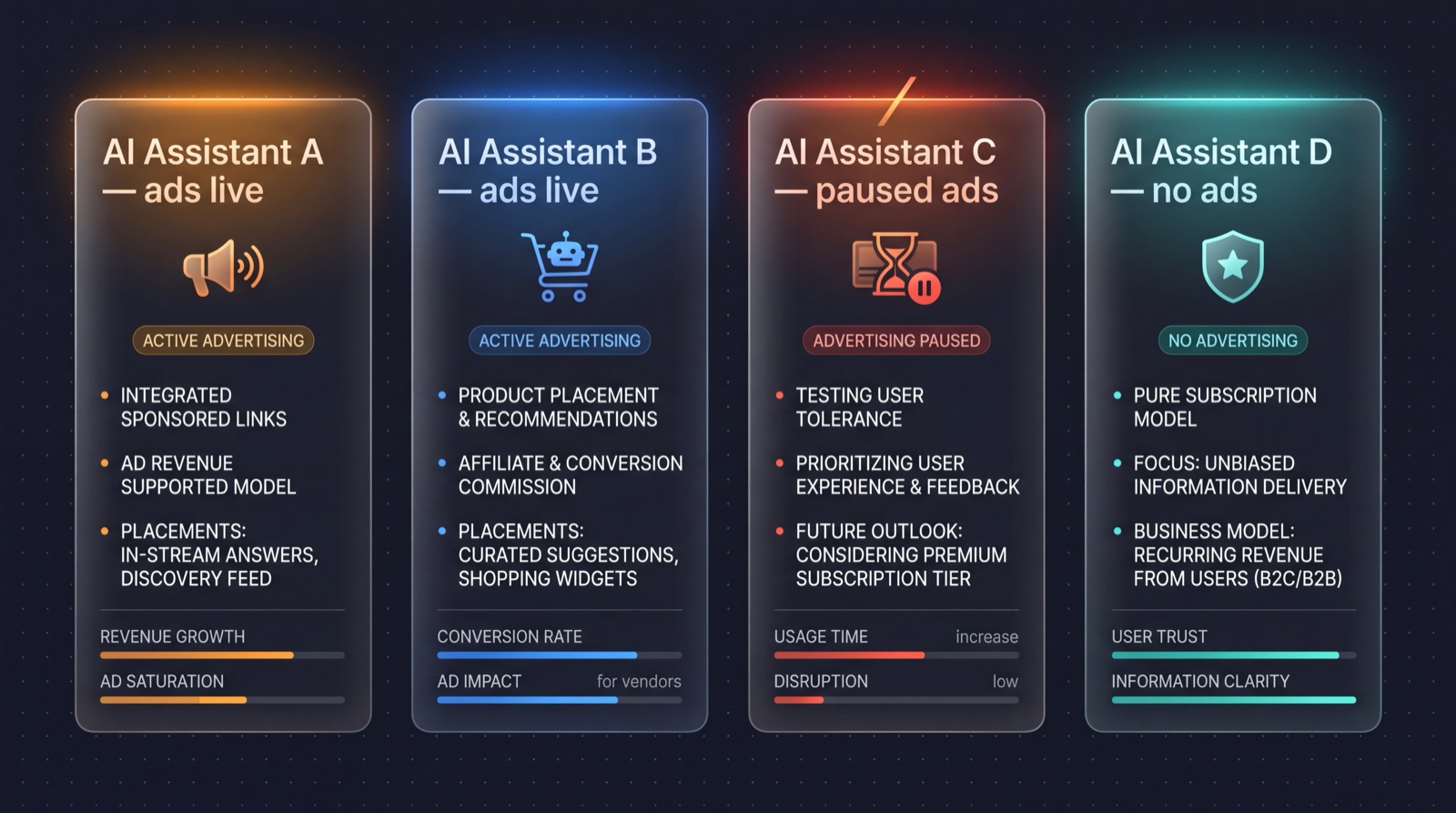
The most common question we get from clients: “Will Claude, Gemini, and Perplexity all have ads soon?” The picture is less uniform than people assume.
- Perplexity experimented first. They launched sponsored follow-up questions in November 2024 with brands like Whole Foods, Universal McCann, and PMG. By October 2025 they had paused new advertisers, and in February 2026 they killed the program entirely, pivoting to a subscription-first model. Their public reasoning was the same one OpenAI is most worried about: once users believe ads might be biasing answers, the integrity of the product erodes. Worth watching, because if ChatGPT users start to feel the same way, OpenAI will be forced to course-correct.
- Anthropic (Claude) has gone the opposite direction publicly. Claude will not carry ads. Anthropic ran ad creative and Super Bowl-adjacent positioning explicitly contrasting itself with ChatGPT’s monetization strategy. Their bet is that enterprise and developer revenue, plus consumer subscriptions, can fund the model without a consumer ad business. If you’re an enterprise marketer worried about brand safety in AI surfaces, Claude is positioned as the “no ads, no influence” option.
- Google AI Overviews already monetize. Alphabet has reported that ads placed above, below, and inside AI Overviews monetize at roughly the same rate as traditional Google search. For practical purposes, if you’re running Google Ads today, you’re already advertising in AI surfaces.
- Gemini hasn’t announced a consumer ad program of the OpenAI-style format yet, but Google’s existing Search and Performance Max ad system is the closest thing to a Gemini “ads platform” today.
The short version: ChatGPT and Google are the two AI ad ecosystems that matter for performance buyers in 2026. Anthropic is staying out by design. Perplexity tried and stepped back. That makes the OpenAI Ads beta one of the few genuinely new auctions you can buy into right now, which is why CPCs and CPMs are still relatively soft.
What every marketer should do in the next 90 days
We tell clients to act on five fronts in parallel.
- Get into the beta. Apply to the self-serve Ads Manager or get a partner relationship live (Pacvue, Kargo, StackAdapt, Criteo, Adobe). Inventory is plentiful and bids are still soft. That window will close.
- Reverse-engineer your top intent conversations. What does someone ask ChatGPT 30 seconds before they’re ready to buy from you? Those are your target conversations. Build creative that lands inside them.
- Stand up the pixel and Conversions API on day one. Without server-side measurement you can’t trust CPA, and you can’t scale spend with confidence.
- Treat ChatGPT as a paid-search-adjacent channel, not a social one. Steal your top-performing Google headlines, recut them inside the 40/150 character limits, and run them.
- Audit your AI visibility on the organic side too. Ad placement and organic citation are different surfaces, but they share signals. If ChatGPT can’t cleanly identify your business, your ads will land on weaker context. AI SEO and OpenAI Ads compound each other.
ChatGPT Ads FAQ — quick answers to common questions
How do I run ChatGPT Ads? Sign up for OpenAI’s beta self-serve Ads Manager (U.S. advertisers only as of Q2 2026), or buy through an adtech partner like Pacvue, Kargo, StackAdapt, Criteo, or Adobe. Pick a Clicks (CPC) or Reach (CPM) objective, build a card under the 40/150 character limits, install the pixel and Conversions API, and start at OpenAI’s recommended $3 to $5 CPC.
How much do ChatGPT Ads cost? CPMs at launch were quoted around $60 and have drifted toward $25 as inventory expanded. CPC bidding turned on in April 2026 with a recommended starting bid of $3 to $5 per click. Most performance buyers should default to CPC over CPM.
Where do ChatGPT Ads appear? Sponsored cards appear at the bottom of a ChatGPT response when the conversation has commercial intent. They’re clearly labeled and visually separated from the organic answer. They never replace, rewrite, or interrupt the AI’s answer. They don’t appear at all in restricted categories like health, mental health, or politics.
Who sees ChatGPT Ads? Only logged-in adult users on the Free and Go plans in the United States. ChatGPT Plus, Pro, Business, Enterprise, and Edu accounts do not see ads.
Are ChatGPT Ads worth it for marketers? For most U.S. brands with commercial-intent customer journeys, yes. Bids are still soft, the auction is contextual rather than profile-based (closer to Google search than to Meta), and inventory is plentiful before competitors arrive. The biggest near-term win is being among the first to build proprietary CPA benchmarks for your category.
What’s the difference between ChatGPT Ads and OpenAI Ads? They’re the same product. “OpenAI Ads” is the official program name. “ChatGPT Ads” is what marketers and the press actually call it because the inventory lives inside ChatGPT.
Will Claude, Gemini, and Perplexity have ads too? Google AI Overviews already monetize and have for some time. Anthropic has publicly committed to keeping Claude ad-free. Perplexity tested ads in late 2024 and shut the program down in February 2026, pivoting to subscriptions. So in 2026, the two AI ad ecosystems performance buyers should learn are ChatGPT Ads and Google.
The bottom line
ChatGPT Ads isn’t a curiosity. It’s a real ad platform with self-serve buying, CPC pricing, conversion measurement, and an audience that already includes hundreds of millions of weekly users. It won’t feel like Meta and it won’t feel exactly like Google. It’s something genuinely new: an auction priced on what people are trying to do, not who they are.
Marketers who treat the next two quarters as a learning sprint will own a measurement edge their competitors won’t have. Marketers who wait until the platform looks “mature” will buy the same inventory at higher prices in 2027.
If you want a paid-media partner who is already running ChatGPT Ads campaigns, building Conversions API integrations for clients, and tracking how AI ad surfaces are reshaping CPA across categories, that’s exactly what we do at MaaS by CodeSM. Get in touch and we’ll benchmark your category and design the ChatGPT Ads test plan with you.
Share this article