On April 14, 2026, Apple unified Business Connect, Business Manager, and Business Essentials into a single Apple Business platform, available across 200+ countries. A few months later, Apple Maps Ads will go live in the U.S. and Canada with iOS 26.5.
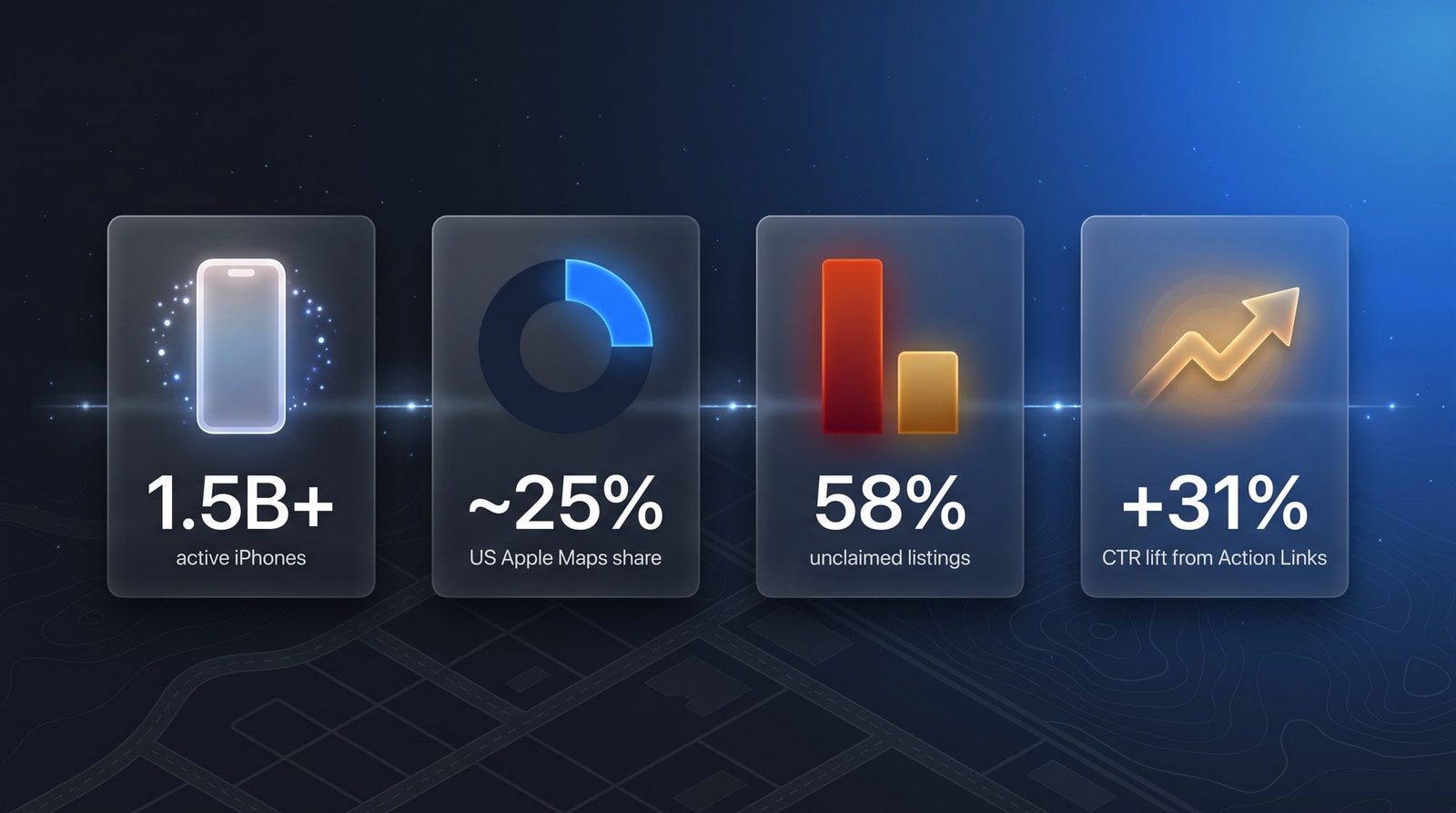
For most marketing teams, that pair of announcements should not feel academic. Apple’s installed base is north of 1.5 billion active iPhones globally. Apple Maps holds roughly a quarter of U.S. mobile navigation share. And — the part that should command attention — 58 percent of U.S. businesses haven’t claimed their Apple Business Connect listing, and only 16 percent actively manage it. That is a long list of competitors not yet showing up in front of an audience that disproportionately holds purchasing power.
This guide covers what Apple Business Connect actually is in 2026, what it means for local SEO, the ranking factors that move the needle on Apple Maps, how it compares to Google Business Profile, whether your brand should invest, and a practical playbook for the next two quarters.
What “Apple Business” actually is in 2026
The April 14 unification rolled three previously separate Apple products into one console:
- Apple Business Connect — the public-facing place card, Showcases, Action Links, and ads (formerly the Maps-focused dashboard).
- Apple Business Manager — fleet device management for Macs, iPads, and iPhones (MDM and Apple IDs).
- Apple Business Essentials — small-business device, storage, and support bundle.
The part that matters for marketing is what used to be Apple Business Connect — now the “Visibility” pillar of Apple Business. The functional modules are:
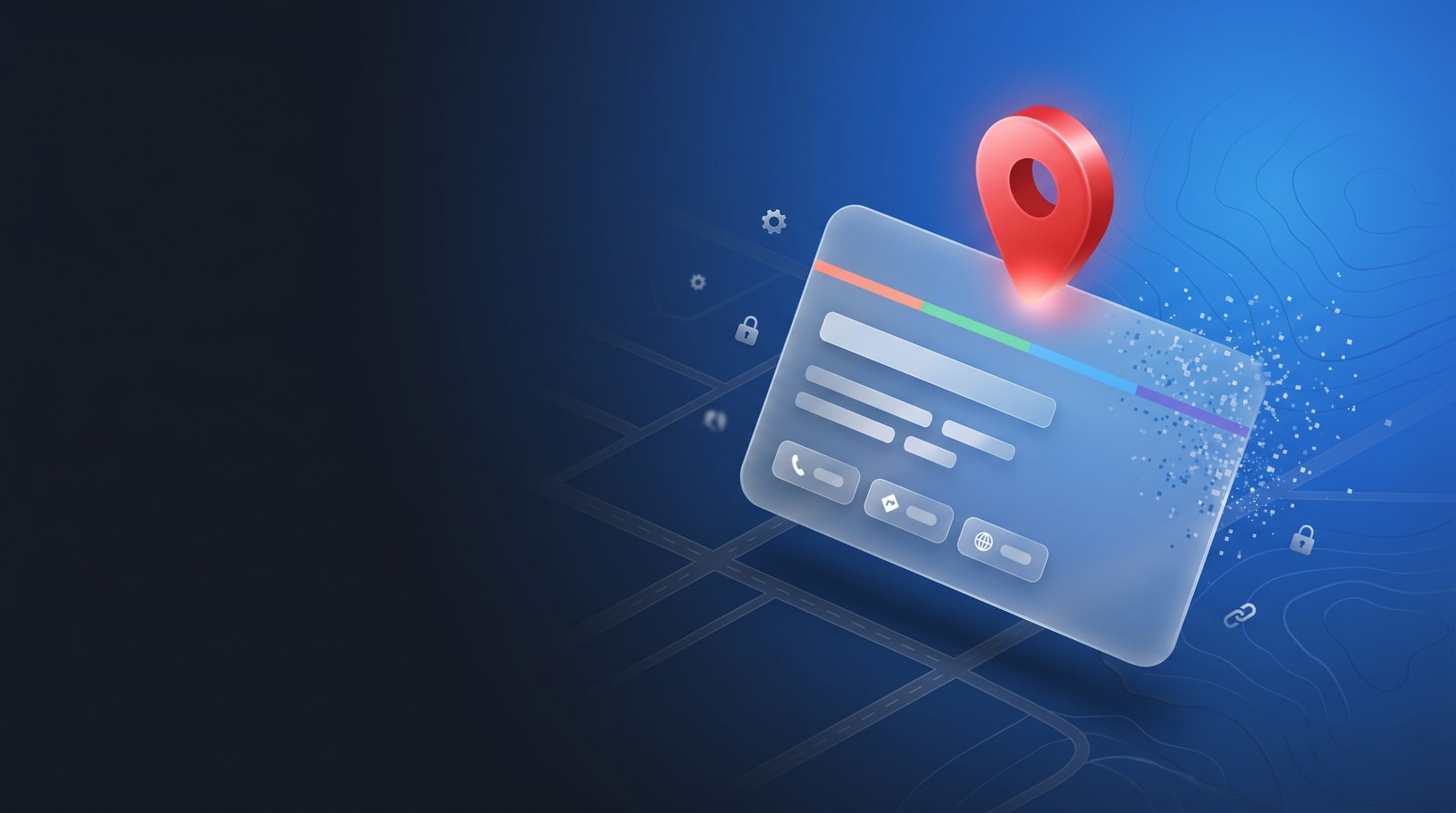
- Place Card. Hours, address, phone, website, photos, categories, and attributes. The core listing that surfaces in Apple Maps, Siri, Spotlight, the Look Around panel, CarPlay search, Messages location shares, Apple Wallet, and the new Vision Pro spatial maps.
- Showcases. Evergreen and seasonal tiles for menus, services, offers, new locations, and announcements. They display inside the place card and influence which businesses surface in category searches.
- Action Links. Deep links into your booking, ordering, reservations, payment, or loyalty partner. Apple maintains a vetted integration list (OpenTable, Resy, Toast, Square, Shopify, Mindbody, Booksy, and dozens more) plus a Custom Action Links option for any URL. Apple reports that businesses using Action Links see roughly 31 percent higher click-through rates on website, call, and action taps combined. Critically, since 2024, Action Links also support UTM parameters, which finally makes Apple Maps traffic trackable in GA4 and other analytics suites.
- Branded Mail, Tap to Pay branding, and Business Caller ID. Cross-channel surfaces that pull from the same Apple Business profile data, so a brand identity established once propagates everywhere across the Apple ecosystem.
- Apple Maps Ads (rolling out Summer 2026). Sponsored top-of-result placement in Apple Maps search, plus inclusion in the new “Suggested Places” section being added in iOS 26.5. Launching in the U.S. and Canada first.
When somebody asks Siri “where’s the closest urgent care?” or types “hardware store” into Spotlight, or pulls up Apple Maps in CarPlay, the place graph they see is built on Apple Business data. That same graph is what Apple Intelligence draws from to compose local answers.

Why Apple Business Connect matters for local SEO
Most marketing teams underestimate Apple Maps because they benchmark the wrong number. The question is not “does Apple Maps have as many users as Google Maps?” The question is “what fraction of my highest-value addressable audience uses Apple Maps as their primary local search surface?” The answers change the math.
A few numbers worth internalizing:
- Apple has 1.3 to 1.5 billion active iPhones globally. The U.S. installed base skews older, higher-income, and more brand-loyal than Android in nearly every developed market.
- Apple Maps holds roughly 25 percent of U.S. mobile navigation share versus Google Maps at around 67 percent. “Second” still means 82 to 110 million U.S. Apple Maps users.
- Around 87 percent of consumers use Google to find local businesses. The remaining 13 percent skew toward iPhone owners with higher discretionary spend.
- 58 percent of U.S. businesses have not claimed their Apple Business Connect listing, and only 16 percent actively manage it. Most categories therefore have far lower competitive density on Apple Maps than they do on Google.
The strategic read: Apple Maps is not the bigger channel by raw volume, but it is the channel where competitive density is dramatically lower. Most of your competitors are still treating it as a 2018 secondary listing. That gap is where a brand that acts now buys cheap visibility in front of an above-average audience — and feeds the entity graph that AI systems (Apple Intelligence, ChatGPT, Perplexity, Gemini, Google AI Overviews) increasingly use to verify local truth.
What actually ranks you in Apple Maps
Apple is more opaque about its ranking algorithm than Google is, but the signals that consistently move rankings — based on Apple’s own documentation and credible third-party research — are well understood:
- Profile completeness. Apple favors fully completed place cards — hours (including holiday hours), all relevant categories (primary plus secondaries), attributes (parking, accessibility, payment types, pet-friendly), photos, description, and Action Links. Empty fields hurt.
- NAP consistency across the entity graph. Apple cross-references your Google Business Profile, Yelp, Tripadvisor, your website schema, and other public sources. Conflicting hours or addresses across them down-weights the listing because Apple’s confidence drops.
- Reviews on syndicated platforms. Apple does not host its own reviews. Instead it syndicates from Yelp, Tripadvisor, Vagaro, and similar partners. Volume, recency, and average rating all feed Apple Maps rank. This is the single most underestimated Apple ranking factor.
- User engagement. Direction taps, call taps, website taps, and Action Link taps are positive signals. Showcases and active Action Links increase the surface area for engagement to happen.
- Photo quality and quantity. Real, current, high-resolution interior and exterior photos outperform stock. Look Around contributions for storefronts are a differentiator only Apple offers — Google has no equivalent.
- Showcases freshness. A place card with three active Showcases outperforms an empty one in category searches.
What is conspicuously NOT on this list: inbound backlinks (the way Google uses them), publishing frequency on your blog, or schema density on your website. Apple’s algorithm lives in its own world and rewards a different kind of optimization than Google does.
How Apple Business Connect compares to Google Business Profile
The two platforms look superficially similar — both are free, both are place-graph dashboards, both want accurate, verified location data. But they were built around different assumptions about the user, the merchant, and the operating model.
| Google Business Profile | Apple Business Connect | |
|---|---|---|
| Audience composition | Cross-platform, all demos | iOS-skewed, higher income, 35+ |
| Primary surfaces | Google Search, Maps, Waze | Apple Maps, Siri, Spotlight, CarPlay, Vision Pro |
| Search behavior | Typed query in search box | Voice (Siri), Spotlight, category browse |
| Reviews source | First-party native | Syndicated (Yelp, Tripadvisor, Vagaro) |
| Posts cadence | Weekly+, time-sensitive | Showcases — evergreen, fewer, polished |
| Q&A | Native | Not supported |
| Messaging | Native | Not supported |
| UTM-trackable links | Yes (mature) | Yes (since 2024) |
| Analytics depth | Search terms, photo views, calls, web clicks | Place card views, action taps, spatial insights |
| Ads | Local Service Ads, Performance Max | Apple Maps Ads (Summer 2026) |
| Multi-location bulk | Native, mature | API + approved partner (Yext, Uberall, Rio SEO, SOCi, Reputation) |
| US claim rate | High | ~42% claimed; only ~16% actively managed |
The mistake most marketing teams make is treating Apple Business Connect like a Google Business Profile clone. It is not. Apple rewards a structurally complete place card, polished Showcases, well-configured Action Links, and reputation strength on Apple’s syndicated review partners — not the keyword-rich Posts and Q&A churn that move Google. Frequent Google Posts will not move your Apple rank; cleaning up your Yelp average will.
Should your brand invest in Apple Business Connect?
The honest answer for most brands is “yes, but as a thoughtful #2 priority, not as your top-of-list quarterly initiative.” Here is the framework that works.
Invest heavily if any are true:
- You have brick-and-mortar locations and your audience over-indexes on iPhone — luxury, premium services, urban density, age 35+.
- You are a multi-location brand and your category is already competitive on Google. Apple is the cheaper second front.
- You operate in hospitality, dining, retail, automotive, or services where “find one near me right now” is the dominant search intent.
- You have already invested in cleaning up your entity graph (Wikipedia, Wikidata, Yelp, Tripadvisor, LinkedIn). Apple compounds that work.
- You sell in verticals where voice search via Siri is meaningful — restaurants, gas, urgent care, pharmacies, ATMs, dentists.
Invest moderately if:
- You are national in reach but with a smaller physical footprint.
- You are an SMB with one or two locations and limited bandwidth — claim and complete the listings now, but do not over-invest yet.
- Your Google Business Profile management is already mature and you have time to add a second channel.
Deprioritize if:
- You are pure-DTC e-commerce with no physical retail.
- You are B2B SaaS with no local-search-driven demand.
- You have no analytics or local-team bandwidth to support a second channel responsibly.
The mistake is going to one extreme — ignoring Apple entirely because Google is bigger, or treating Apple as a fully equivalent peer and over-investing in tactics that won’t move the algorithm. Calibrate to your audience composition.
The 2026 Apple Business Connect playbook
If you are starting from zero (or close to it), here is the sequence we would run for a portfolio of locations.
- Audit claim status across your portfolio. Pull every location and check what is claimed, what is verified, what is still on the legacy Maps Connect model, and what has been migrated to the new unified Apple Business platform.
- Reconcile NAP across the entity graph. One source of truth — usually your DAM or a master spreadsheet — pushed consistently to Apple Business Connect, Google Business Profile, Yelp, Bing Places, Tripadvisor, and your website schema. Apple cross-references all of them.
- Stand up a Showcases publishing cadence. Three to five active Showcases per location, refreshed monthly or quarterly. Treat it as merchandising, not content marketing.
- Wire up Action Links with UTM parameters. Every booking, ordering, reservation, gift card, and loyalty partner — with UTM strings flowing into your analytics so you can finally see Apple-sourced revenue.
- Deploy Look Around imagery for flagship locations where the exterior or interior is a competitive asset. This is one of the few visibility advantages Apple offers over Google.
- Run a reputation push on the syndicated sources — Yelp, Tripadvisor, Vagaro — because Apple inherits those signals. The fastest way to move Apple rank is to fix Yelp. See our reputation management approach for the operational details.
- Add Apple Business Connect analytics to your monthly reporting. Place card views, direction taps, call taps, Action Link conversions, Showcases engagement. Direction taps are a clean conversion proxy.
- Decide partner versus manual operating model. Above 25 multi-location brands or 10+ different small clients, the math favors a paid integrator (Yext, Uberall, Rio SEO, SOCi, Reputation). Below that, a 30-minute monthly checklist per location is usually enough.
- Pilot Apple Maps Ads when they go live. Start with a 90-day test in your most competitive metros. CPCs will be lower than Google’s local ads for the first 6 to 12 months while the surface is new and uncrowded.
- Make Apple part of your entity-graph strategy, not a standalone project. Apple Business Connect is one of a small number of trusted nodes that AI systems verify your business against. Investment here improves your local AI visibility everywhere, not just on iOS. We covered this in our post on local AI search in 2026.
The bottom line
Apple Business Connect is no longer a “should we or shouldn’t we” question. The April 14, 2026 unification of Apple’s business platform plus the summer 2026 launch of Apple Maps Ads moved it from “interesting secondary channel” to “core local SEO surface for any brand with a physical footprint and an audience that includes iPhone users.”
The opportunity, for marketing teams willing to do the work that 84 percent of competitors are not, is buying disproportionately cheap visibility in front of a disproportionately valuable audience, in the channel that AI systems are increasingly using as their source of local truth.
If you want help running an Apple Business Connect audit across your portfolio, reconciling your entity graph, or building the operational cadence to compete on iOS local search, that is exactly what the local SEO team at MaaS by CodeSM does for clients every day. Get in touch and we will benchmark your category and map the plan.
Share this article