


Most small and mid-sized law firms do not have a marketing plan. They have a website built a few years ago, a Google Ads account someone checks when the phone goes quiet, and a referral network that works until the attorney who fed them cases retires. For personal injury, family, criminal defense, immigration and estate planning firms, that gap is expensive. Legal is the most expensive category in paid search: LocaliQ’s 2026 benchmarks put the average cost per click for attorneys and legal services at $9.87 and the average cost per lead at $131.63, the highest of the 23 industries tracked, against $5.42 and $66.69 across all industries.
The bigger leak is usually after the click. When Clio’s researchers secret-shopped 500 firms for the 2024 Legal Trends Report, only 40% picked up the phone and only 33% answered an email. Meanwhile, in Scorpion’s 2025 survey of 3,000 U.S. adults, 72% said they move on if a firm does not respond within 24 hours. Add AI assistants to the mix (in BrightLocal’s 2026 survey, 45% of consumers used ChatGPT or another AI tool for local recommendations, up from 6% a year earlier) and the firms that win in 2027 are the ones that know which cases they want, what they can pay to get one, and how fast they answer.
This guide covers why most law firm marketing fails, the benchmarks that should set your budget, the advertising rules to check before you spend, and the 10 sections of the plan, with worked examples for consumer practices. At the end, you can download our free fillable PDF workbook to build the plan for your own firm.
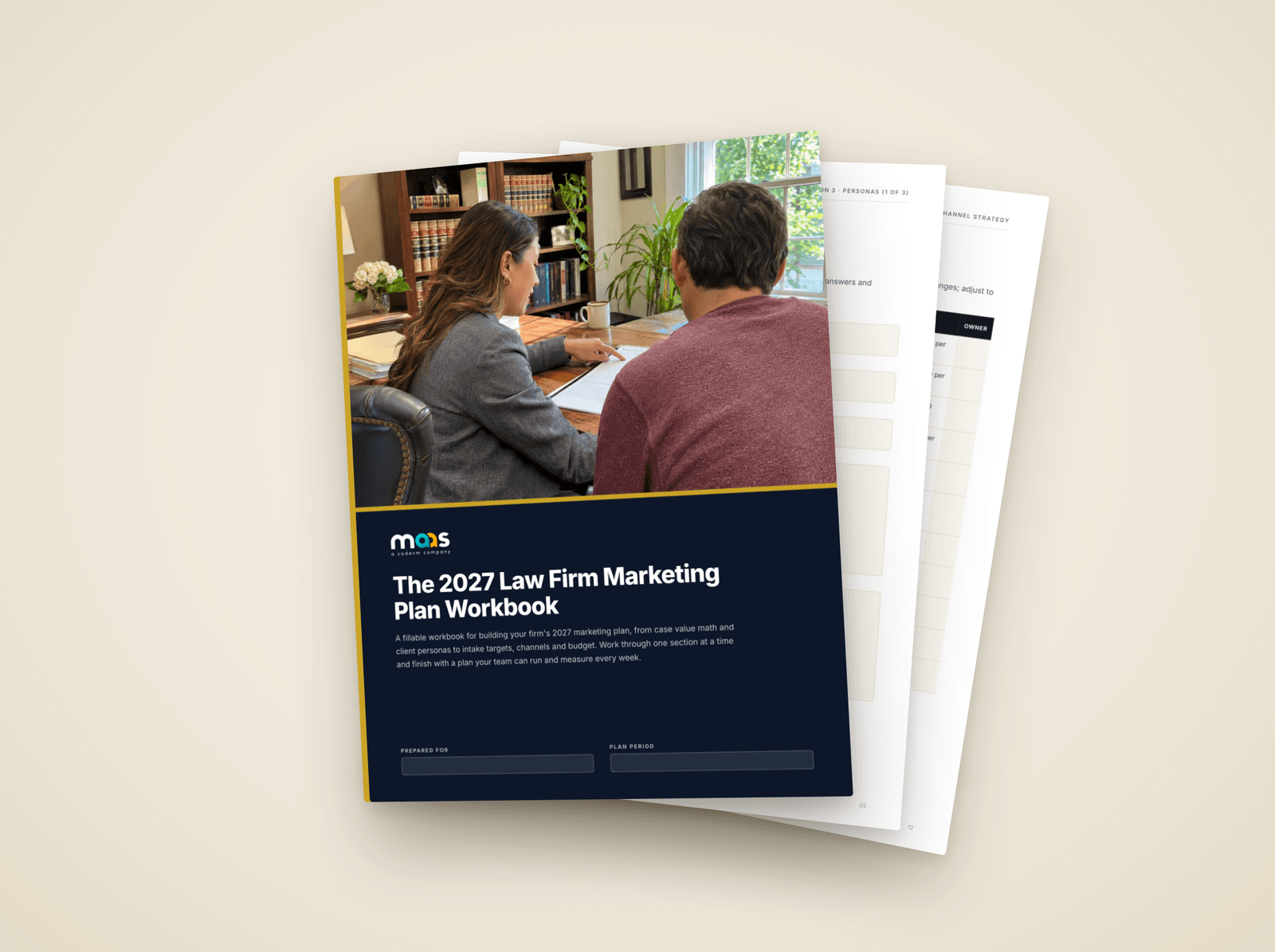
Click to download the free 2027 Law Firm Marketing Plan workbook (PDF)
Why most law firm marketing fails
Legal marketing rarely fails because a firm spent too little. It fails in a few predictable places:
- Buying clicks, losing calls. A firm pays $100+ for a lead, then sends it to voicemail at 5:30 p.m. or calls back the next morning. In consumer law the first credible firm that answers usually gets the consultation.
- Marketing the firm instead of the case. One homepage tries to sell personal injury, divorce and wills at once. People search for a specific problem in a specific city (“DUI lawyer in San Antonio”, “abogado de inmigración cerca de mí”), and they convert on a page that speaks to that problem.
- Counting leads, not signed cases. Without a lead source field in the case management system, nobody can say which channel produced last quarter’s retainers, so budget follows opinion.
- Referrals treated as luck. Few firms track who refers, thank them consistently, or notice when a source goes quiet.
- Reviews as an afterthought. Five reviews from 2021 lose to 140 from last year, whatever the quality of the lawyering.
- Ignoring language. Many potential clients would rather hire in Spanish, and most competitors offer a translated contact page at best.
- Compliance last. Ads written by a generalist agency promise results, call the firm “the best”, or use testimonials the state bar would not allow.
A written plan forces the decisions in advance: which practice areas to grow, what a signed case is worth, what you will pay for one, and how every inquiry gets answered.
The 2027 economics of law firm marketing
Start with case value math, not channel preferences. The number that matters is cost per signed case, by practice area:
Cost per signed case = cost per lead ÷ (share of leads that book a consultation × share of consultations that sign)
At the benchmark $131.63 cost per lead, a firm that books 50% of leads and signs 40% of consultations pays about $658 per signed case. Improve intake to book 70% and sign 50%, and the same ad spend costs about $376 per case. Intake is often the cheapest way to lower your acquisition cost.
Costs vary widely by practice area. LocaliQ’s legal benchmarks (median figures from campaigns that ran April 2022 to March 2023, so treat them as directional) show:
| Practice area | Avg cost per click | Avg cost per lead |
|---|---|---|
| Accidents and personal injury | $9.30 | $159.17 |
| Criminal law | $12.30 | $101.49 |
| Family law (incl. divorce) | $7.69 | $103.54 |
| Estate and probate (incl. wills) | $7.92 | $72.24 |
Immigration is not broken out in that data set, so test it with a small budget before committing.
Three more numbers belong in your plan:
- Reviews set the shortlist. In BrightLocal’s 2026 survey, 97% of consumers read reviews for local businesses, 68% will only use a business rated four stars or higher, 74% look for reviews from the last three months, and 47% won’t use a business with fewer than 20 reviews.
- Spanish is a market, not a translation. About 44.9 million people in the U.S. spoke Spanish at home in 2024, roughly 1 in 7 people age 5 and older, according to Census Bureau survey data.
- Speed decides. A Harvard Business Review study of online leads found firms that responded within an hour were nearly 7 times as likely to qualify the lead as firms that waited even one hour longer.
Budget. There is no reliable public benchmark for law firm marketing spend as a share of revenue. A common planning range for consumer practices is 2% to 10% of gross revenue, with competitive personal injury markets often higher. A better method: set a target cost per signed case for each practice area (well below the average fee or expected contingency fee), then fund the channels that hit it.
| Channel | What it is good for | Benchmark or typical cost |
|---|---|---|
| Google Search Ads | Urgent, high-intent case types (PI, criminal, DUI) | Legal avg CPC $9.87, CPL $131.63 (LocaliQ 2026) |
| Google Local Services Ads | Pay-per-lead placement above search ads, with a Google verification badge | You pay per lead, not per click (Google); price varies by practice area and market |
| Google Business Profile + local SEO | Map pack visibility for “[practice] lawyer near me” | Free; staff or agency time |
| Practice-area SEO content | Research-phase cases (estate planning, divorce, immigration) | Planning range: $1,500 to $5,000/month |
| Review program | Raises conversion on every other channel | Software $50 to $300/month (planning range) |
| Meta Ads | Awareness, retargeting, seminars, family and estate planning | Legal lead costs not published; all-industry lead campaign CPL is $27.39 (LocaliQ 2026), expect higher |
| Referral network | High-trust cases from attorneys, CPAs, advisors, community groups | Time; limited by bar rules on paying for referrals |
Rules to know before you market
This section is practical guidance, not legal advice. Your state’s rules control, and most bars offer ethics hotlines or advertising review.
- ABA Model Rule 7.1: nothing false or misleading. That includes leaving out a fact needed to keep a statement from misleading. Results, comparisons (“the best”) and implied guarantees are where firms get in trouble. See the ABA Model Rules.
- Rule 7.2: advertising and paying for recommendations. You can advertise in any medium, but you cannot give anything of value for recommending your services, with exceptions for the reasonable cost of advertising, qualified lawyer referral services, non-exclusive reciprocal referral agreements the client is told about, and nominal thank-you gifts. A comment to the rule allows paying lead generators, as long as they do not recommend you and the payment is not a fee split. You may not claim to be a certified specialist unless an approved body certified you, and each ad must name at least one responsible lawyer or firm with contact information (see the ABA’s summary of the 2018 amendments).
- Rule 7.3: no live solicitation. In-person, live phone and real-time video solicitation for pecuniary gain is prohibited, except with other lawyers, people you have a family, close personal or prior professional relationship with, and routine business users of the service. States vary on written outreach.
- Some states are stricter. Florida requires non-exempt ads to be filed with the Bar for review under Rule 4-7.19. The Bar’s current filing coversheet lists a $250 fee per ad filed at least 20 days before first use ($750 if late), a 30-day wait before sending direct mail or email about an injury, accident or disaster, and an English translation for any ad in another language. Texas requires filing ads and solicitation communications with the State Bar’s Advertising Review Committee under Rule 7.04, with exemptions in Rule 7.05.
- And some just changed. New York’s amended rules took effect June 1, 2026. They track the ABA model more closely and dropped the “Attorney Advertising” label requirement and the 30-day blackout for personal injury solicitations. Old checklists go stale, so confirm the current version of your state’s rules before a campaign launches.
- Reviews. The FTC’s rule on consumer reviews and testimonials bans fake reviews, incentives conditioned on positive reviews, undisclosed insider reviews and review suppression. Combined with Rule 7.2, the safe approach is to ask every client and offer nothing in return.
- Confidentiality and texting. Client stories need informed consent (Rule 1.6). If you text or auto-dial leads, the TCPA applies, so collect written consent on your forms.
The 10-section law firm marketing plan framework
The workbook has a fillable page for each section. Here’s what goes in each.
1. Business snapshot
One page: practice areas and the revenue share of each, fee model (contingency, flat fee, hourly), average fee per matter, offices and counties served, languages spoken by attorneys and intake staff, intake hours, and how many new matters per month you can take on. Finish with one sentence on what makes the firm different. If every competitor could say it (“aggressive representation, personal attention”), keep working.
2. SWOT analysis
- Strengths: trial record, bilingual attorneys, a well-known name partner, fast intake, flat-fee clarity.
- Weaknesses: thin reviews, no after-hours answering, one referral source that drives half the cases, a dated site.
- Opportunities: an underserved language or county, a practice area competitors ignore, Local Services Ads in your category, AI answers that do not mention anyone in your market yet.
- Threats: national PI advertisers with TV budgets, lead-generation sites reselling your clients, rising CPCs, rule changes, a key attorney leaving.
3. Client personas
Consumer legal clients fall into three patterns. Build one persona of each for every practice area you want to grow.
- The Urgent Caller. Just arrested, just injured, just served with papers. Searches on a phone within hours, calls two or three firms, and hires the first one that answers, sounds competent and can explain the next step. Criminal defense, DUI and personal injury live here. Channels: Google Search, Local Services Ads, the map pack, a phone answered by a person.
- The Careful Researcher. Facing a divorce, a green card petition, or a parent’s estate. Takes weeks or months, reads, asks friends, watches videos, asks ChatGPT, and compares fees. Family law, immigration and estate planning live here. Channels: practice-area pages, FAQ content, reviews, videos, an easy consultation booking and a nurture sequence.
- The Referred Client. Sent by another attorney, a past client, a CPA, a financial advisor, a church or community group. Already half decided, checks your reviews and site to confirm, and expects a fast, warm first call. Channels: referral relationships, reviews, a site that matches what the referrer said.
For each persona, fill in: case type, trigger event, urgency, language preference, how they search, what they fear, what proof they need, and the fee question they will ask first.
4. Competitive analysis
Pick five firms you lose cases to. For each, record: practice areas promoted, Google rating and review count, Local Services Ads presence, Google Ads presence, Spanish-language pages and intake, after-hours response (call them at 7 p.m. and find out), fee transparency, and depth of practice-area content. Then ask ChatGPT and Google’s AI Mode who the best [practice area] lawyer in your city is, and note who gets named. Our AEO guide covers how to read those answers.
5. Positioning statement
“For [client], [firm] is the [practice-area] firm that [differentiator] because [proof].”
Worked example (fictional firm): “For working families in Hidalgo County facing a removal hearing or a family petition, Rivera & Ochoa is the bilingual immigration firm that answers in Spanish or English within 15 minutes, seven days a week, because every intake specialist on our team is bilingual and an attorney reviews every new case within one business day.”
No result is promised and every claim is provable, which is the Rule 7.1 standard for every line of copy.
6. Goals and KPIs
Three to five SMART goals, tied to signed cases, not traffic. Examples:
- Grow signed personal injury cases from marketing from 8 to 12 per month by Q4 2027, holding cost per signed case under $1,500.
- Answer 90% of intake calls live during business hours and return every missed call or form within 15 minutes by March 31.
- Raise the family law consultation-to-retainer rate from 35% to 45% by June 30.
- Reach 150 Google reviews averaging 4.7 or higher across both offices by December 31.
- Launch Spanish practice-area pages for the top three case types by the end of Q2.
Weekly KPIs: leads by practice area and source, live answer rate, time to first contact, consultations booked, show rate, retainers signed, cost per signed case, and new reviews.
7. Client journey map
- Trigger event. An arrest, an accident, a separation, a visa deadline, a death in the family.
- Search or ask. Google, Local Services Ads, ChatGPT, a friend, another lawyer.
- Shortlist. Reviews, the practice-area page, language options, a quick look at fees.
- First contact. Call, form, chat or text. Speed is the KPI.
- Intake screening. Conflict check, qualifying questions, urgency.
- Consultation. In person, phone or video.
- Engagement. Fee agreement and signed retainer.
- Case work. Regular updates, a named contact, no surprises on fees.
- Resolution. The moment to ask for a review.
- Referral. Past clients and the professionals who sent them.
Most firms invest in stages 2 and 4 and neglect 8 through 10, where reviews and referrals come from.
8. Channel strategy
Investment figures are planning ranges for a small to mid-sized consumer firm in a mid-sized metro. Adjust to your market.
| Channel | Role | Cadence | Typical investment |
|---|---|---|---|
| Google Business Profile (each office) | Map pack, reviews, calls | Weekly posts, monthly photos | Free + 1 hr/week |
| Local Services Ads | Pay-per-lead for core case types | Always on, weekly lead review | $1,000 to $5,000/mo |
| Google Search Ads | High-intent capture by practice area | Always on | $2,000 to $15,000/mo |
| Practice-area pages + SEO | Rank for case type + city, in English and Spanish | 2 to 4 pages or articles/mo | $1,500 to $5,000/mo |
| Review program | Steady, recent reviews | Ask at every resolution | $50 to $300/mo |
| Referral network | Attorney, CPA, advisor and community referrals | Monthly touchpoints | Time + events |
| Meta Ads | Retargeting, seminars, awareness | Always on or seasonal | $500 to $3,000/mo |
| Short video (YouTube, Reels) | Attorneys answering real questions | 2 to 4 videos/mo | Time + light production |
| Email and SMS nurture | Researchers, past clients | Monthly + triggered | $50 to $300/mo tool |
| Directories and lawyer referral services | Citations, credibility, LRS leads | Quarterly audit | Varies by service |
| Call tracking + CRM | Attribution, intake follow-up | Always on | $100 to $500/mo |
Run Spanish as its own set of pages, ads and intake scripts, not a translation plugin. Our work with Matulewicz Law Firm, an immigration practice in McAllen, is an example: paid search built around its immigration and asylum services, aimed at a bilingual audience. Call tracking makes the table measurable (see our dynamic number insertion explainer).
9. Content strategy and calendar
Build practice-area pages first, then answers to the questions clients ask in every consultation, then short videos of attorneys answering them. A realistic cadence: 2 to 4 pages or articles and 2 to 4 short videos per month, 3 social posts a week, and a monthly email to past clients.
- Practice-area pages. One per case type per city, in each language you serve.
- “What happens next” explainers. The first 72 hours after an arrest.
- Attorney Q&A video. 60 to 90 seconds, one question, captioned.
- Local process guides. Courthouses, filing timelines, local forms.
- Fees and process. How flat and contingency fees work.
- Law changes. New statutes, immigration policy updates.
- Client stories. With written consent and required disclaimers.
- Team and community. Bilingual staff, sponsorships, pro bono work.
10. Budget allocation and measurement
Example split for a $15,000/month budget at a two-office consumer firm:
- Google Search Ads: $5,250 (35%)
- Local Services Ads: $2,250 (15%)
- SEO and content, English and Spanish: $3,000 (20%)
- Reviews, intake and call tracking tools: $1,500 (10%)
- Meta Ads and video: $1,500 (10%)
- Referral and community programs: $750 (5%)
- Testing reserve: $750 (5%)
Measurement: a required lead source field in your case management system (Clio, MyCase, Filevine, Lawmatics or similar), recorded call tracking, conversion tracking in Google Ads and GA4, and a monthly report of signed cases and fees by source. The weekly dashboard uses the KPIs from section 6.
Common mistakes to avoid
- Sending ads to the homepage. Each practice area and language needs its own landing page.
- Voicemail after hours. Urgent callers do not leave messages. Use live answering or on-call intake.
- Judging channels by lead volume. Twice the leads and half the signed cases is the worse channel.
- Machine-translated Spanish. Have a native speaker write pages and scripts, and staff intake to match the ads.
- Incentives for reviews. No gift cards, no discounts, no filtering unhappy clients out of the ask.
- Copy the bar would flag. “Specialist”, “guaranteed”, “best”, or past results without required context.
- One-channel dependence. If one source drives half your cases, the plan’s first job is a second source.
Where to start if you’re starting from scratch
- Week 1. Sections 1, 3 and 5: snapshot, personas, positioning. Do the cost per signed case math for your top two practice areas. Three hours.
- Week 2. Claim and complete Google Business Profile for every office, plus Apple Business Connect and Bing Places. Set up a review request at case resolution. Four hours.
- Week 3. Audit intake. Call your own firm at lunch and after hours. Add call tracking, a lead source field and a 15-minute response standard. Four hours.
- Week 4. Build landing pages for your top two case types, in Spanish too if your market calls for it. Have them reviewed against your state’s rules. Six hours.
- Month 2. Launch Local Services Ads and Google Search Ads for those two case types with tight negative keyword lists.
- Month 3. Build the weekly dashboard. List your top 20 referral sources and schedule a touchpoint with each.
- Quarter 2. Start the content program: practice-area pages, FAQ articles and attorney videos. Add a nurture sequence for researchers.
- Year 1. Review signed cases and fees by source, then move budget toward the lowest cost per signed case.
FAQ
How much should a law firm spend on marketing? There is no reliable public benchmark. A common planning range for consumer practices is 2% to 10% of gross revenue, higher in competitive personal injury markets. Set a target cost per signed case by practice area and fund the channels that meet it.
Are Google Local Services Ads worth it for lawyers? Often, for urgent case types. You pay per lead rather than per click, the ads sit above regular search ads, and your reviews show on the listing. Track cost per signed case and dispute invalid leads.
Can lawyers ask clients for reviews? Yes, in most states, as long as reviews are genuine, you offer nothing in exchange, and you don’t disclose confidential information when you respond. Check your state bar’s guidance on testimonials.
What is the 80/20 rule for lawyers? It’s the Pareto principle applied to a practice: a small share of clients, case types and referral sources tends to produce most of the revenue. A marketing plan uses it to find your top case types and sources and put more budget behind them.
What are the 7 parts of a marketing plan? Most versions cover research, target audience, positioning, goals, channels, budget and measurement. This template uses 10 sections so personas, the client journey and content each get their own page.
Download the full template
The workbook is a fillable PDF companion to this guide. Inside:
- How to use the workbook
- Business snapshot
- SWOT analysis
- Three persona templates (Urgent Caller, Careful Researcher, Referred Client)
- Competitive analysis matrix (5 competitors)
- Brand positioning canvas with a worked example
- Goals and KPI tracker with a monthly check-in
- Customer journey map (10 stages)
- Channel strategy matrix
- Content framework and 30-day content calendar
- Budget allocation worksheet with an example split
- Tech stack checklist and weekly measurement dashboard
- 12-month action plan
- Common mistakes checklist and quick-start plan
Download the 2027 Law Firm Marketing Plan workbook (PDF)
If you’d rather have a team run this for you, from practice-area pages and Local Services Ads to intake follow-up and weekly reporting by signed case, that is the work the law firm marketing team at MaaS by CodeSM does every day. Get in touch and we’ll review where your firm stands and map the plan.
Share this article