

A customer with a leaking faucet does not have to search “plumber near me,” open six tabs, compare star ratings, and make three calls anymore. They can ask ChatGPT a much richer question: “Who can repair a leaking kitchen faucet near me before 6 p.m., has strong reviews, and will give me a quote?”
That difference is bigger than a new search box. It changes the unit of competition from a blue link or map pin to a complete, evidence-backed answer.
The latest catalyst is Yelp. Yelp has licensed local business information to OpenAI, giving ChatGPT access to fresher details, ratings, reviews, photos, and transaction options for relevant local searches. That means a Yelp profile can influence what a potential customer sees without that customer ever starting on Yelp.
But let’s clear up the naming first.
The quick answer: “ChatGPT Maps” is not a separate maps app. It is useful shorthand for the maps, place cards, and local result lists that can appear inside ChatGPT Search. Yelp is now one of the data layers that can help power those experiences. It matters more than it did—but there is no public “ChatGPT Maps ranking formula,” and Yelp has not replaced Google Business Profile, Bing, Apple Maps, or your website.
What “ChatGPT Maps” actually is
OpenAI’s documentation for ChatGPT Search confirms that maps can appear as part of a response. ChatGPT can use a person’s approximate location based on their IP address or, when the person explicitly enables it, their device location to improve nearby recommendations. OpenAI says precise location is used for the response and then deleted; the resulting place names and map can remain in the conversation history.
In practice, a local answer can include:
- A map and a short list of nearby businesses
- Clickable place names with additional business information
- Ratings, reviews, photos, hours, and other decision-making details
- Links to the business or the source that supplied the information
- Transaction options, such as restaurant reservation times, when supported
This is a front-end experience inside ChatGPT, not a turn-by-turn navigation product. It is designed to help someone decide where to go or whom to hire, then take the next step.
That experience has three layers marketers need to understand:
- The interface layer: the answer, map, place cards, citations, and action buttons a customer sees.
- The data layer: search indexes, business websites, Yelp, and other trusted providers that help ChatGPT assemble current local information.
- The marketing layer: the listings, location pages, reviews, photos, schema, and operating details your team can actually maintain.
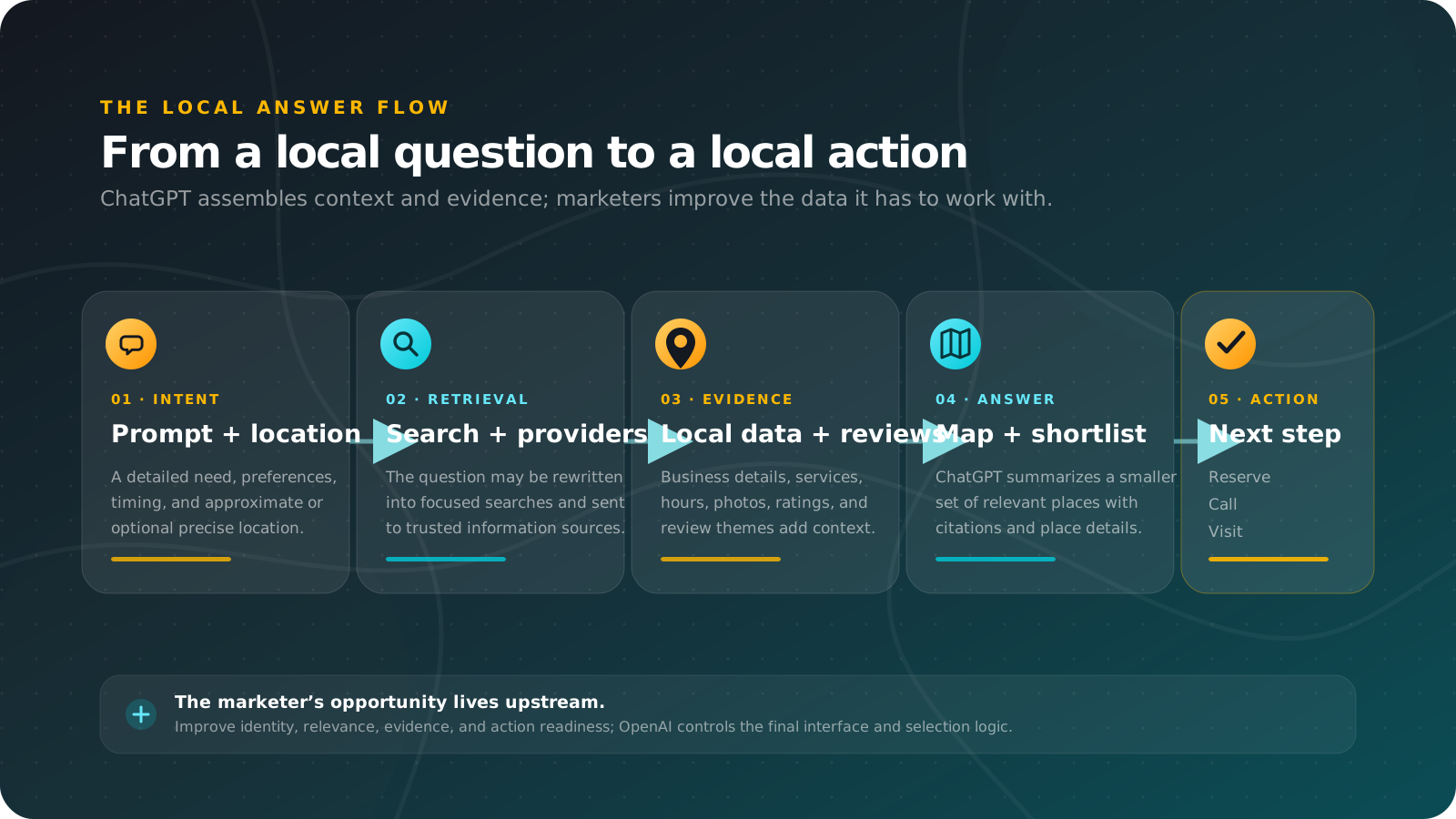
The distinction matters because marketers cannot directly optimize the first layer. OpenAI controls the interface and the selection logic. Your opportunity is to improve the accuracy, depth, and consistency of the information available in the other two.
What changed with the Yelp–OpenAI integration
Yelp disclosed that it had signed an agreement with OpenAI in its Q4 2025 shareholder letter, then confirmed the licensing relationship in its Q1 2026 filing with the SEC. In July 2026, more of the consumer-facing scope became public.
According to Search Engine Land’s reporting on the deal, ChatGPT can surface Yelp business details, ratings, reviews, and photos in response to relevant local questions. When Yelp content is used, Yelp branding and links can accompany it. The agreement is non-exclusive, and its financial terms were not disclosed.
The practical addition is not merely “more reviews.” It is a structured local dataset with details an answer engine can use to match a specific request:
- Business name, address, phone number, and location
- Categories and individual services
- Hours, price level, service area, and closure status
- Amenities and attributes such as outdoor seating, accessibility, or whether dogs are allowed
- Ratings, review counts, review excerpts, and common themes
- Business and customer photos
- Reservation, ordering, or lead options when supported
Yelp describes its local data as continuously refreshed with daily business updates and new reviews. That gives ChatGPT a way to supplement older web pages or model knowledge with current operational details. It also creates a new consequence for stale listings: an incorrect closing time or missing service can now travel beyond Yelp into an AI-generated answer.
From recommendation to transaction
The integration is also moving beyond discovery. OpenAI says ChatGPT can display restaurant availability from supported third-party providers. Yelp reservation availability is supported in the U.S. and Canada, alongside other reservation partners in their respective markets.
Yelp’s Request a Quote capability for local services has also been announced for ChatGPT local searches. Treat that as an evolving rollout, not a universally available button. Availability can vary by category, market, account, and query.
The direction is clear, though: local AI search is becoming less like a directory and more like a concierge. The answer does not have to end with “Here are three links.” It can end with a reservation, a visit to a place page, or eventually a service inquiry.
Why the Yelp deal matters for marketing
The biggest change is not the source logo under a result. It is the compression of the customer journey.
| Traditional local search | Conversational local search |
|---|---|
| A short keyword such as “Italian restaurant Austin” | A detailed request such as “quiet Italian restaurant in South Austin with outdoor seating and a table for four tonight” |
| A map pack followed by manual comparison | A curated shortlist with the comparison already summarized |
| Reviews are a separate research step | Review themes can become part of the answer |
| The customer visits several sites to check fit | The assistant can combine location, attributes, reputation, and availability |
| Conversion happens after multiple clicks | A reservation or other action may appear inside the experience |
This creates four marketing consequences.
1. Specificity becomes an advantage
A complete profile gives an answer engine more ways to match a business to a detailed need. “Restaurant” is weak data. “Mexican restaurant with a dog-friendly patio, vegan options, weekday happy hour, and reservations” can satisfy a much narrower—and often much more valuable—prompt.
This does not prove that filling in one field improves a hidden ChatGPT ranking score. OpenAI has not published one. It does mean that missing or ambiguous information gives the system less evidence to use when the user asks for that exact attribute.
2. Review language can shape the recommendation
In traditional local SEO, teams tend to fixate on the average rating and total review count. Those numbers still matter to human buyers, but an answer engine can also synthesize what reviewers repeatedly say: careful crew, easy parking, quiet dining room, slow weekend service, excellent gluten-free menu, or fast emergency response.
That is why your reputation is becoming structured marketing intelligence. Our deeper guide to Yelp’s role in AI search explains how detailed reviews give AI systems more context than a star-only rating.
There is an important rule here: do not ask customers for Yelp reviews. Yelp prohibits businesses from soliciting or incentivizing reviews. Focus on delivering a review-worthy experience, making customers aware that you are on Yelp, and responding thoughtfully when reviews happen organically.
3. A data error can become a lost recommendation
If your website says you serve three counties, Yelp lists only one city, and your hours differ across directories, a customer is not the only one left guessing. The systems assembling local answers have to reconcile the conflict too.
Consistency is not glamorous, but it reduces uncertainty. Every location should have one authoritative name, address, phone number, URL, set of hours, service area, and category structure. Multi-location brands need this discipline at the individual-location level, not just at headquarters.
4. Your “owned” and “rented” presence now work together
Yelp is an important source, not the whole local web. ChatGPT Search can query the web and work with third-party providers. OpenAI also tells site owners that allowing OAI-SearchBot to crawl their sites is important for inclusion in ChatGPT Search.
Your business website still needs clear location and service pages, useful copy, current facts, internal links, and machine-readable markup. Google Business Profile still matters for Google. Apple Business Connect matters across Apple’s local surfaces. Bing, vertical directories, local publications, and community mentions can all help establish the same business as a coherent entity.
The resilient strategy is not “go all-in on Yelp.” It is make every credible source agree about who you are, what you do, where you operate, and why customers choose you.
The Local Answer Stack: what marketers should optimize
Instead of chasing rumors about a new ranking algorithm, organize the work into four layers we call the Local Answer Stack.
Layer 1: Identity
Can ChatGPT and its providers confidently identify the business?
- Use the same business name, address, phone number, and canonical location URL everywhere.
- Claim every Yelp Business Page and remove or merge duplicates.
- Give each location its own page, hours, service area, and contact details.
- Keep temporary closures and holiday hours current.
Layer 2: Relevance
Can the available data prove that the business fits the request?
- Choose the most specific Yelp categories that accurately describe the business.
- Add every relevant service under those categories.
- Complete attributes and amenities customers actually use to decide.
- Write clear “From the business” information without stuffing keywords.
- Publish focused service and location pages on your own site.
Yelp’s business-information guide confirms that owners can maintain basic details, categories, services, amenities, hours, service areas, and business descriptions. Fill them out for customers first; the machine readability is a valuable side effect.
Layer 3: Evidence
Can the system find trustworthy proof that the business delivers?
- Add recent, high-quality photos that show real work, products, spaces, and people.
- Give business-uploaded photos accurate, useful captions.
- Respond to reviews with empathy and specific context rather than boilerplate.
- Address recurring complaints operationally instead of trying to bury them.
- Publish original case studies, team credentials, service details, and local expertise on your site.
Avoid turning review responses into keyword soup. “Thanks for choosing our Austin emergency plumbing leak repair service” reads like a robot wearing a name tag. A genuine response that references the issue, the resolution, and what the team will improve is better for customers and more credible as source material.
Layer 4: Action
Can a high-intent customer take the next step?
- Keep the website, phone number, reservation link, and other conversion destinations current.
- Enable the transaction tools that make sense for your category.
- Monitor response speed for messages, reservations, and future quote requests.
- Make mobile landing pages fast, specific, and consistent with the listing that sent the visit.
This final layer is easy to neglect. Visibility without availability creates a polished dead end.
Do Yelp Ads guarantee visibility in ChatGPT?
No verified source says they do.
Yelp Ads can create paid visibility within Yelp and may be useful for businesses whose customers actively use the platform. That is a separate decision from optimizing the organic business information licensed to other products. The OpenAI licensing agreement does not establish a public pay-to-appear rule for ChatGPT’s local answers.
If a sales pitch claims you must buy Yelp Ads to show up in ChatGPT, ask for the product documentation that proves it. As of August 2026, OpenAI has not published that requirement.
Treat paid Yelp media the way you would any other channel: evaluate audience fit, lead quality, cost per qualified lead, and incrementality. Do not buy it as an insurance policy against an undocumented algorithm.
A 30-day ChatGPT local-search playbook
You do not need a six-month “AI transformation” project to improve the underlying signals. Start with one focused month.
| Week | Priority | Actions | Deliverable |
|---|---|---|---|
| 1 | Audit the entity | Compare Yelp, your website, Google Business Profile, Bing Places, and Apple Business Connect. Record conflicts in names, addresses, phone numbers, hours, categories, URLs, and service areas. | One location-by-location discrepancy sheet with owners and deadlines. |
| 2 | Enrich the data | Complete Yelp categories, services, attributes, amenities, descriptions, hours, links, service areas, and recent photos with captions. Correct duplicates and closed locations. | A complete, current Yelp Business Page for every location. |
| 3 | Strengthen owned evidence | Improve location and service pages, add useful FAQs, verify LocalBusiness schema, connect relevant internal pages, and confirm that OAI-SearchBot is not blocked. | Crawlable pages that state exactly what each location offers and prove it. |
| 4 | Measure the experience | Run a fixed set of local prompts from relevant markets. Record whether the brand appears, which facts are accurate, which sources are cited, whether a map appears, and which actions are available. | A baseline AI local-visibility scorecard to repeat monthly. |
For a multi-location business, sample at least one branded prompt and several non-branded prompts for every priority market. A restaurant group might test “best lunch near [neighborhood],” “quiet dinner with outdoor seating,” and “table for six tonight.” A home-services company might test emergency, specialty, availability, and service-area language.
Run the same prompt more than once and keep the conditions consistent. AI answers can vary, so a single result is an anecdote—not a ranking report.
What to measure after the audit
Do not collapse this work into one vague “AI visibility” percentage. Track the parts you can diagnose:
- Mention rate: How often the business appears across the approved prompt set
- Factual accuracy: Whether hours, locations, services, and attributes are correct
- Citation mix: Which third-party and owned sources appear
- Map presence: Whether the response includes a map or place cards
- Recommendation context: Which needs or qualities the business is associated with
- Action availability: Whether the user can reserve, call, visit, or continue to the correct page
- Downstream results: Leads, bookings, calls, and qualified site sessions where attribution is available
Use those observations to decide what to fix. If ChatGPT names the business but gets the hours wrong, that is a data-consistency problem. If it cites competitors’ service guides but your site has only a generic homepage, that is a content gap. If the business never appears for a service it genuinely offers, inspect categories, service pages, reviews, and third-party coverage before assuming you need more ad spend.
This is the operational side of LLM SEO: making the business easy for answer engines to identify, understand, verify, and recommend.
ChatGPT Maps and Yelp FAQ
Is ChatGPT Maps a separate app?
No. “ChatGPT Maps” is an informal name for the maps and local result interfaces that can appear within ChatGPT Search. ChatGPT is not replacing a turn-by-turn navigation app.
Does ChatGPT use Yelp for local results?
Yes. Yelp has confirmed a licensing agreement with OpenAI, and Yelp business details, ratings, reviews, and photos can appear in relevant ChatGPT local responses. Yelp is one source in a broader search and data ecosystem.
Does Yelp replace Google Business Profile for AI search?
No. Google Business Profile remains foundational for Google’s ecosystem. A durable local strategy also includes the business website, Bing, Apple Business Connect, Yelp, and relevant industry or community sources.
Do Yelp Ads make a business appear in ChatGPT?
There is no published guarantee or documented requirement that a business must buy Yelp Ads to appear in ChatGPT local answers. Assess Yelp Ads on their measurable paid-media performance, not on an unsupported promise of ChatGPT placement.
Can customers reserve or request quotes through ChatGPT?
ChatGPT can show restaurant reservation times from supported providers, including Yelp in the U.S. and Canada. Yelp’s Request a Quote integration has been announced for local-service searches, but availability may vary as the experience rolls out.
Should businesses ask customers for Yelp reviews?
No. Yelp’s policy prohibits soliciting or incentivizing reviews. Build awareness of your Yelp presence, deliver a strong customer experience, and let reviews happen organically.
The bottom line
The Yelp integration makes ChatGPT better at a job that matters enormously to local businesses: turning a complicated, location-specific need into a confident next step.
That does not mean marketers should abandon the map pack and move the entire budget to Yelp. It means the local-search surface area has expanded again. Your website, profiles, reviews, photos, operating details, and conversion paths now have to work as one connected system.
The businesses that benefit will not be the ones chasing a magic “ChatGPT Maps ranking factor.” They will be the ones that are easiest to identify, most relevant to the request, best supported by credible evidence, and ready to serve the customer.
If you want to know how your locations appear across ChatGPT, Yelp, Google, Bing, and Apple—and where inconsistent data or weak evidence is costing you visibility—our SEO and AI-search team can build the baseline and the operating plan. Talk with MaaS by CodeSM before your customers ask an AI for a recommendation your competitors are better prepared to win.
Share this article