


Most independent practices market the way they run a busy clinic day: one patient at a time. A provider leaves and the website still lists them. A new location opens with a Google profile somebody created on their phone. The front desk asks “how did you hear about us?” and writes nothing down. And the tracking pixel the web vendor installed four years ago is still firing on the appointment request form.
That approach gets more expensive every year. In rater8’s patient surveys, 84% of patients check online reviews before choosing a new provider, and in its April 2026 survey 55% said a review had made them avoid or cancel a booking. The same survey found that 47% of patients used AI tools such as ChatGPT to research providers, up from 31% a year earlier. Paid search still works, but the average healthcare lead from Google costs $66.02, and the privacy rules about what you can track on a medical website are stricter than in any other local business category.
This guide lays out a 2027 marketing plan for independent and multi-location practices: primary care, specialty, urgent care, and dental and orthodontic offices. It covers why most practice marketing stalls, the benchmarks that should set your spend, the rules to know before you run an ad, and the 10 sections of a plan your team can actually run. At the end you can download a free fillable PDF workbook to complete for your own practice.
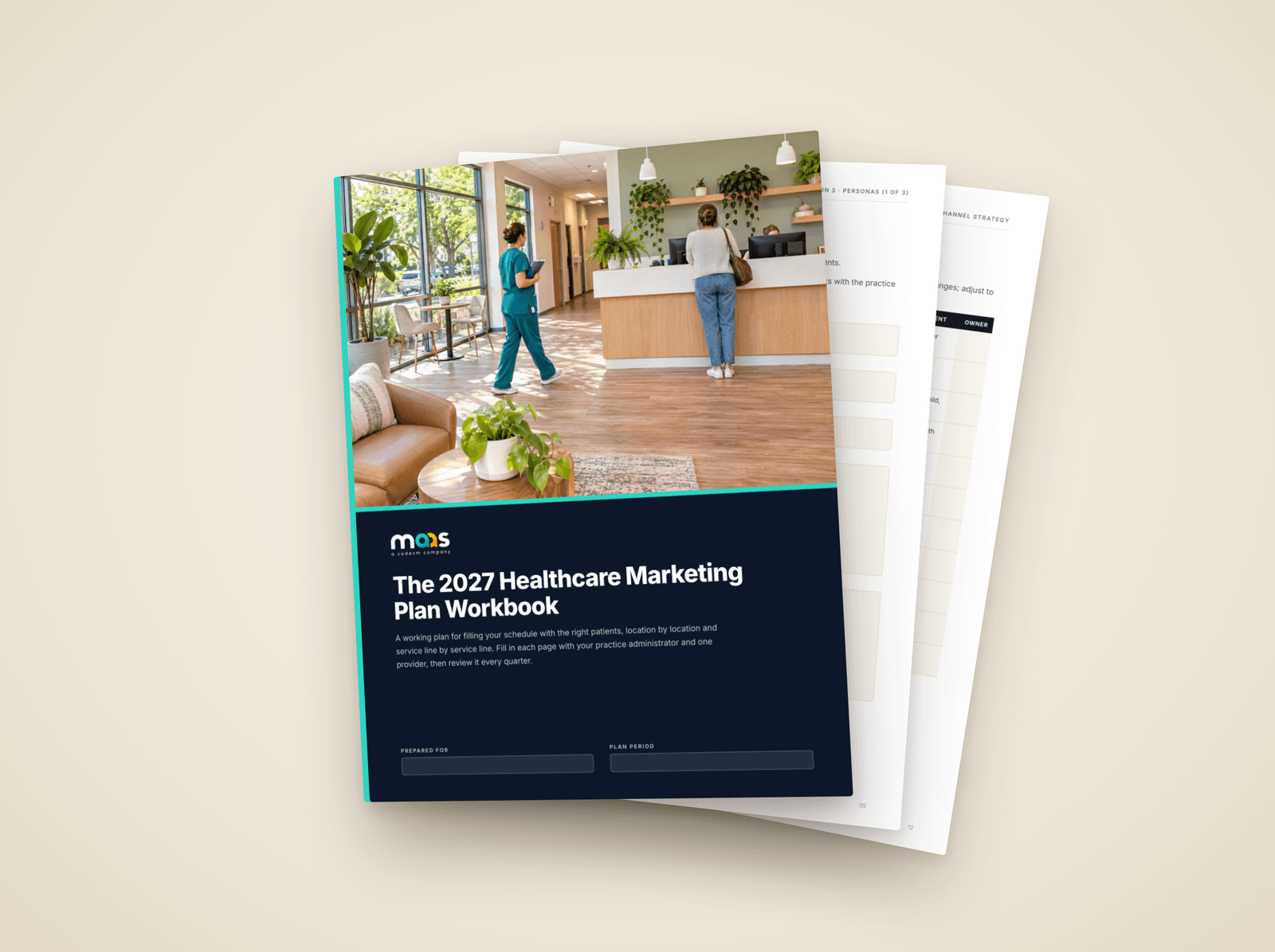
Click to download the free 2027 Healthcare Marketing Plan workbook (PDF)
Why most medical practice marketing fails
Patient demand mostly exists already. People get sick, move, turn 50, chip a tooth, need a sports physical. What fails is everything between that need and a booked appointment:
- Marketing the practice instead of the service line. “Comprehensive care for the whole family” matches no one’s search. Patients search for a service, a symptom, a provider type and an insurance plan. A practice with insured primary care, a self-pay weight management program and same-day sick visits is running three businesses with three different buyers.
- One Google profile for a group that needs eight. A three-location group with five providers often has one claimed profile, two unclaimed duplicates and a departed physician’s listing still collecting reviews. Map rankings are decided location by location.
- Tracking nobody has audited. A Meta Pixel on the appointment form, session recording on the portal login page, analytics capturing URLs with condition names in them. This is exactly the setup federal regulators wrote their tracking guidance about.
- Leads that die at the front desk. Ads and SEO produce phone calls. A front desk juggling check-ins lets them ring out, and nobody measures missed calls or form response time.
- No recall or reactivation. The cheapest appointment to fill belongs to a patient already in your system who is overdue for an annual visit, a follow-up or a hygiene recall. Most practices spend their whole budget on strangers.
- No measurement past “how did you hear about us.” Without call tracking and source capture tied to booked new patients, every budget decision is a guess.
A written plan forces the answers onto paper, gives each one an owner, and tells you within a month when something is off.
The 2027 economics of healthcare marketing
Paid search is still the fastest channel, and costs vary sharply by specialty. LocalIQ’s healthcare search advertising benchmarks (3,542 US campaigns, October 2024 to September 2025) put the healthcare average at $5.64 per click, an 8.09% conversion rate and $66.02 per lead. By specialty:
| Specialty (Google search ads) | Avg. CPC | Conversion rate | Avg. cost per lead |
|---|---|---|---|
| Dermatology | $4.90 | 25.33% | $18.54 |
| Ophthalmology | $4.95 | 18.29% | $30.88 |
| Emergency medicine | $2.29 | 6.89% | $41.68 |
| General practice and family medicine | $5.47 | 11.63% | $62.80 |
| Orthodontics | $8.76 | 14.21% | $71.52 |
| Hospitals and clinics | $4.90 | 6.10% | $72.97 |
| General dentistry | $7.03 | 7.74% | $84.77 |
| Urology | $5.64 | 4.61% | $111.05 |
Source: LocalIQ. LocalIQ reports medians, which keeps outliers from skewing the numbers.
LocalIQ’s broader 2026 search benchmarks put Physicians and Surgeons at $40.04 per lead against a $66.69 all-industry average, with Dentists and Dental Services at $72.97. On Facebook, its 2026 benchmarks show $32.14 per lead for Physicians and Surgeons and $61.56 for dentists.
Reputation decides the click. With most patients checking reviews and more than half willing to skip a provider over them, review volume and rating per location are conversion levers, not vanity metrics.
AI answers are a new front door. AI tools build their answers from your website, profiles, directories and reviews, so consistent facts across all of them matter. Our AEO guide covers how that works.
Budget. There is no reliable public benchmark for practice marketing spend. A common planning range is 2% to 5% of annual collections for an established practice, and more for a new location, a new provider who needs a full panel, or a self-pay service line that gets no help from insurer directories. Adjust it to your market and your capacity.
Know what a patient is worth. Multiply average annual collections per active patient by the average years a patient stays. That lifetime value, set against cost per booked new patient, tells you whether a $60 lead is cheap or expensive.
| Channel | What it is good for | Benchmark or typical cost |
|---|---|---|
| Google Business Profile (per location and provider) | Map results for “near me,” specialty and provider-name searches; reviews | Free; 84% of patients check reviews |
| Google search ads | High-intent searches by service and specialty | $66.02 average healthcare cost per lead |
| Meta ads | Self-pay programs, new locations, events, community awareness | $32.14 per lead for physicians, $61.56 for dentists |
| SEO: service-line, condition and location pages | Compounding organic demand; source material for AI answers | Planning range: $1,500 to $5,000 per month in content and technical work |
| Directories and booking platforms (Zocdoc, Healthgrades, insurer directories) | Insured patients searching by plan and next availability | Varies by platform; compare subscription and per-booking terms |
| Recall and reactivation (email, SMS, portal) | Filling open slots from existing patients | Often bundled with your PM/EHR or patient engagement tool |
| AI assistants (ChatGPT, Gemini, AI Overviews) | Being named when patients ask for a recommendation | 47% of patients used AI tools to research providers |
| Physician and community referrals | Specialty practices and new providers | Staff and provider time |
Rules to know before you market
This is a practical summary, not legal advice. Check specifics with your compliance officer or healthcare counsel.
HIPAA’s marketing rule. Using patient information for “marketing” generally requires the patient’s written authorization (HHS). Telling your own patients about your own services, recall reminders and care coordination generally fall outside that definition. Being paid by a drug or device company to promote its product to your patients does not. Any vendor that handles patient information for you, such as a texting platform, CRM or call-recording service, needs a business associate agreement (BAA).
Online tracking. OCR’s bulletin on online tracking technologies, revised in March 2024, says pixels and analytics that send protected health information to a vendor need a BAA or patient authorization. On June 20, 2024, a federal court in AHA v. Becerra vacated one part of it: the position that an IP address combined with a visit to a public, unauthenticated page about a condition or provider is protected information. OCR withdrew its appeal on August 29, 2024, and the rest of the bulletin was left intact (McDermott Will & Emery). We found no newer OCR guidance replacing it as of November 2026. In practice: keep ad pixels and session recording off patient portals, logged-in pages and any form where a patient types a name and a reason for visit. If a vendor won’t sign a BAA, keep patient information away from it.
State health privacy laws. Some states now regulate consumer health data outside HIPAA. Washington’s My Health My Data Act requires consent to collect it and has banned geofencing within 2,000 feet of a healthcare facility since July 23, 2023 (Reed Smith). Check the rules in every state where you have a location.
Review responses. OCR has settled several cases over replies to online reviews: a New Jersey psychiatric practice paid $30,000 in 2023 after disclosing diagnosis and treatment details in Google review replies, and two dental practices paid $23,000 and $10,000 (HIPAA Journal). You may respond; you may not confirm that the reviewer is a patient. A safe template: “Thank you for sharing this. Privacy rules keep us from discussing anyone’s care online, but we take every concern seriously. Please call our practice manager at [number] so we can look into it directly.”
Asking for reviews. Google’s policy bars selectively soliciting positive reviews or offering incentives, so no “if you loved your visit” gating. The FTC’s rule on fake reviews and testimonials, in effect since October 2024, adds civil penalties for fake, insider and suppressed reviews (FTC). Ask every patient, the same way.
Ad platform limits. Google treats health as a sensitive category for personalized ads: ads about health conditions and treatments can’t use advertiser-curated audiences such as remarketing lists or Customer Match. Since January 2025, Meta has restricted the lower-funnel data health and wellness advertisers can send and optimize on. Plan campaigns around search intent, location and broad audiences, not retargeting.
Self-pay pricing. Under the No Surprises Act, patients who aren’t using insurance are entitled to a good faith estimate of expected charges. Build it into any self-pay campaign’s booking flow.
Claims. Check your state medical or dental board’s advertising rules before using words like “specialist,” “board certified” or “best.”
The plan framework, section by section
The workbook has a fillable page for each of these 10 sections.
1. Business snapshot
One page: locations, providers and specialties, hours, service lines (split into insured and self-pay), payer mix, and new-patient capacity per provider per week. Capacity is the line most plans skip. If a physician has no new-patient openings until March, marketing her this month wastes money. Add your current wait for a new-patient visit and one sentence on why a patient should pick you.
2. SWOT analysis
Be specific to healthcare. Strengths: same-week access, evening hours, a provider who speaks Spanish, in-house labs or imaging, strong ratings at one location. Weaknesses: long new-patient waits, phones that ring out, thin reviews at a newer location, a dated site with no online booking. Opportunities: a growing suburb with too few primary care doctors, a self-pay service no one nearby offers, an employer group with no on-site clinic partner. Threats: retail clinics and telehealth apps, hospital systems buying nearby practices, payer rate cuts, a provider departure that takes patients along.
3. Patient personas
Three personas cover most practices:
- The Network Checker. Insured, often new to the area or newly switched plans, looking for a primary care doctor or specialist who is in-network, nearby and taking new patients. Checks insurance, reviews and next availability, in that order. Wins go to the practice with clear plan lists and online booking.
- The Same-Day Searcher. Sick now, or a child is. Searches “urgent care near me” or “doctor open Saturday” and picks from the map in minutes based on hours, wait time, distance and rating. Your Google profile is the whole sales process.
- The Self-Pay Shopper. Paying out of pocket for something insurance doesn’t cover or that they choose to pay for: aesthetics, weight management, a membership primary care plan, a sports physical, clear aligners. Compares prices, results and reviews across several practices and expects transparent pricing.
For each, fill in: insurance status, the exact search terms they use, decision criteria, booking preference (phone, online, walk-in), what makes them hesitate, and the message that moves them. Your fourth audience is the patients you already have; the journey map and channel plan treat them separately.
4. Competitive analysis
Pick five practices patients compare you with, including any retail clinic or hospital-owned group nearby. For each, record: Google rating and review count per location, next available new-patient appointment (call and ask), insurance plans accepted, online booking, providers and specialties listed, and whether self-pay prices are published. Then write one sentence on where you can win, usually access, clarity or reviews at a specific location.
5. Positioning statement
One sentence:
“For [patient], [practice] is the [category] that [differentiator] because [reason to believe].”
Example: “For working families in north Austin who need a doctor they can actually get in to see, Larkfield Family Medicine is the independent primary care practice that offers same-week new-patient visits and evening hours at three locations, because every provider keeps protected new-patient slots each day.”
If you write the sentence and it could describe every practice in town, keep going.
6. Goals and KPIs
Three to five SMART goals, each with an owner and a weekly check-in. Examples:
- Book 140 new-patient appointments a month across three locations by June 2027, up from 95.
- Hold cost per booked new patient under $150 for insured primary care, measured monthly.
- Reactivate 600 patients overdue for an annual visit by the end of Q3 2027.
- Answer 90% of calls live during business hours and return missed calls within 15 minutes.
- Reach a 4.7 average rating with 150 or more reviews on each location profile by December 2027.
Track booked and kept appointments, not form fills. A lead that never shows up is a cost, not a result.
7. Patient journey map
- Need. A symptom, a move, a new plan, a recall postcard, a referral.
- Search. Google, Maps, an insurer directory, an AI assistant, a neighborhood group.
- Compare. Reviews, provider bios, hours, distance.
- Insurance and availability check. Plan list, next open slot, self-pay price.
- First contact. Call, online booking, form, text. Response time decides more bookings here than any ad.
- Booking and intake. Confirmation, digital forms, reminders, a good faith estimate for self-pay.
- Visit. Wait time, front desk, provider, checkout.
- Follow-up. Results, next steps, satisfaction check.
- Recall. Annual visit, chronic care follow-up, hygiene, screenings.
- Review and referral. A consistent review request to every patient, and referrals to family.
Most practices are weakest at stages 4, 5 and 9: unclear insurance information, slow first response, and no recall system.
8. Channel strategy
Investment figures are planning ranges for a one to five location practice. Adjust to your market.
| Channel | Role | Cadence | Typical investment |
|---|---|---|---|
| Google Business Profile, each location | Map visibility, reviews, booking link | Weekly posts, monthly photos | Free + 1 hr/week per location |
| Practitioner profiles | Rank for provider names and specialties | Monthly review | Staff time |
| Website: service-line and location pages | Convert search traffic, answer insurance questions | Update quarterly | $3,000 to $15,000 build, then upkeep |
| SEO and content | Compounding organic demand and AI visibility | 2 to 4 pages or articles/month | $1,500 to $5,000/month |
| Google search ads | Capture high-intent searches by service line | Always on | $2,000 to $10,000/month |
| Meta ads | Self-pay programs, openings, events | Campaign bursts | $500 to $3,000/month |
| Directories and booking platforms | Insured patient discovery | Keep data current monthly | Varies by platform |
| Recall and reactivation | Fill open slots from existing patients | Monthly campaigns, automated reminders | $100 to $500/month in tools |
| Review program | Build volume and rating per location | Every visit, automated | $200 to $500/month |
| Referral outreach | Specialist referrals from PCPs and community | Monthly visits or lunches | Time + modest budget |
| Community events | Health fairs, school and employer screenings | Quarterly | $500 to $5,000 per event |
Run insured and self-pay service lines as separate campaigns with separate landing pages and separate KPIs. Insured lines are measured on booked new patients and payer mix; self-pay lines on revenue per consult.
9. Content strategy and calendar
A sustainable mix for most practices is 3 to 4 social posts a week (mostly short video and carousels), 2 to 4 web pages or articles a month, and one patient newsletter. Rotate these categories:
- Service-line explainers. What the service is, who it is for, insurance and price.
- Provider introductions. Short videos with languages, interests and approach.
- What to expect. First visit, a procedure, a telehealth appointment.
- Insurance and pricing. Plans you accept, self-pay prices, how deductibles work.
- Seasonal health. Flu shots, back-to-school physicals, allergy season.
- Condition education. Plain-language articles reviewed by a named clinician.
- Community. Health fairs, school partnerships, sponsorships.
- Practice news. New provider, new location, extended hours.
Patient stories, photos and videos need a signed HIPAA authorization, every time. When in doubt, feature staff and providers.
10. Budget allocation and measurement
An example $12,000 monthly budget for a three-location practice:
- Google search ads: $4,500
- SEO and content: $2,500
- Meta ads: $1,200
- Directories and booking platforms: $800
- Photo and video production: $800
- Listings and reputation tool: $500
- Recall and patient messaging: $400
- HIPAA-ready call tracking and analytics: $400
- Contingency: $900
Measurement. Use call tracking and form tools that will sign a BAA, capture source on every booking, and keep patient data out of ad platforms. The weekly dashboard: new-patient appointments booked by source and location, cost per booked new patient, live answer rate, missed-call callback time, form response time, new-patient show rate, new reviews and rating per location, and open new-patient slots in the next 14 days. The workbook includes a dashboard template.
Common mistakes to avoid
- Advertising providers with no openings. Check capacity before every campaign and shift budget to providers who need patients.
- Retargeting with health data. Both platforms limit it and it creates HIPAA risk. Build campaigns on search intent instead.
- Replying to reviews with details. Never confirm someone was seen, even to correct them.
- Burying insurance information. A current list of accepted plans on every location page answers the question that decides most bookings.
- Ignoring the recall list. Overdue patients cost less to book than any lead. Work the list every month.
- Treating every location the same. Each location has its own map ranking, reviews and competitors. Report on each one separately.
Where to start if you’re starting from scratch
- Week 1. Sections 1, 3 and 5: snapshot (with capacity), personas and positioning. Two hours with the practice administrator and one provider.
- Week 2. Audit every Google Business Profile, location and practitioner. Claim, merge or remove duplicates. Fix hours, categories, insurance info and booking links. Three hours.
- Week 3. Tracking audit: list every pixel, tag and session recorder on the site and portal, and remove or replace anything that touches patient information without a BAA. Four hours with your web vendor.
- Week 4. Set up a consistent review request after every visit and a response policy that never confirms patient status. Two hours.
- Month 2. Build or fix service-line pages for your top three service lines, separated into insured and self-pay. Launch Google search ads on those lines only.
- Month 3. Run your first reactivation campaign to patients overdue for an annual visit or recall. Start the weekly dashboard.
- Quarter 2. Add an SEO content plan, provider videos and a referral outreach routine. Review cost per booked new patient by channel and move budget.
- Year 1. Full plan review: capacity, payer mix, location performance and next year’s service-line priorities.
FAQ
What is the best way to advertise a medical practice? Start with what patients use to choose: an accurate Google Business Profile for each location, strong recent reviews, and a website with clear service-line, insurance and booking information. Then add Google search ads on your highest-value services. Ads work far better once those basics are in place.
What are the 5 P’s of healthcare marketing? Most versions use product (your services), price (insurance and self-pay costs), place (locations, hours, telehealth), promotion (how patients hear about you) and people (providers and staff). Some frameworks add process and physical evidence to make seven. A plan should have an answer for each.
How much should a medical practice spend on marketing? There is no reliable public benchmark. A common planning range is 2% to 5% of collections for an established practice, more when opening a location, adding a provider or launching a self-pay service line. Set it against your cost per booked new patient and the lifetime value of a patient.
Can a medical website use Google Analytics or the Meta Pixel? On public pages, more flexibly since the June 2024 court ruling. On patient portals, logged-in pages and forms where patients enter health information, only with a vendor that signs a BAA or with patient authorization. Have your tracking audited before you rely on it.
How should a practice respond to a negative review? Briefly and without confirming the reviewer is a patient. Thank them, say privacy rules prevent discussing care online, and give a direct phone number for the practice manager. OCR has fined practices for including patient details in replies.
Download the full template
The fillable PDF workbook is the companion to this guide. Inside:
- How to use the workbook
- Business snapshot
- SWOT analysis
- Three persona templates (Network Checker, Same-Day Searcher, Self-Pay Shopper)
- Competitive analysis matrix (5 competitors)
- Brand positioning canvas with a worked example
- Goals and KPI tracker with a monthly check-in
- Customer journey map (10 stages)
- Channel strategy matrix
- Content framework and 30-day content calendar
- Budget allocation worksheet with an example split
- Tech stack checklist and weekly measurement dashboard
- 12-month action plan
- Common mistakes checklist and quick-start plan
Download the 2027 Healthcare Marketing Plan workbook (PDF)
If you would rather have a team run the plan, from location profiles and review programs to service-line pages, HIPAA-aware tracking, ads and reporting, that is what the healthcare marketing team at MaaS by CodeSM does, for practices such as RGV Adult Medicine and Hewitt Dental. For more on building reviews, see ways to get more reviews. Get in touch and we’ll review where your practice stands and map the plan with you.
Share this article