


Public communicators head into 2027 with more to do on the same budget line. Cities, counties, utilities and special districts face a fixed accessibility deadline: under the Justice Department’s ADA Title II rule, web content and mobile apps must meet WCAG 2.1 Level AA by April 26, 2027 for governments serving 50,000 or more people, and by April 26, 2028 for smaller governments and special districts. At the same time, residents get much of their local news from places agencies don’t control. In Pew Research Center’s 2024 study, 52% of U.S. adults said they at least sometimes get local news from online forums such as Facebook groups or Nextdoor, while 35% get it from local government agencies.
Economic development corporations face a different test. In the 2026 State of Site Selection Pulse Check from the Site Selectors Guild and Development Counsellors International (DCI), consultants named utility and infrastructure capacity as the top reason a location gets eliminated (61%), followed by the lack of an available suitable site (53%) and workforce availability and quality (51%). Much of that screening happens before anyone calls the EDC.
Most public entities still run without a written marketing plan. Communications is often one person, the calendar follows meeting agendas, the budget is set a year ahead, and every purchase goes through procurement. This guide covers both halves of public-sector marketing: communicating with residents and attracting, retaining and growing businesses. It includes the rules to build in, the 10 sections of the plan and a sample budget, and at the end you can download a free fillable PDF workbook.
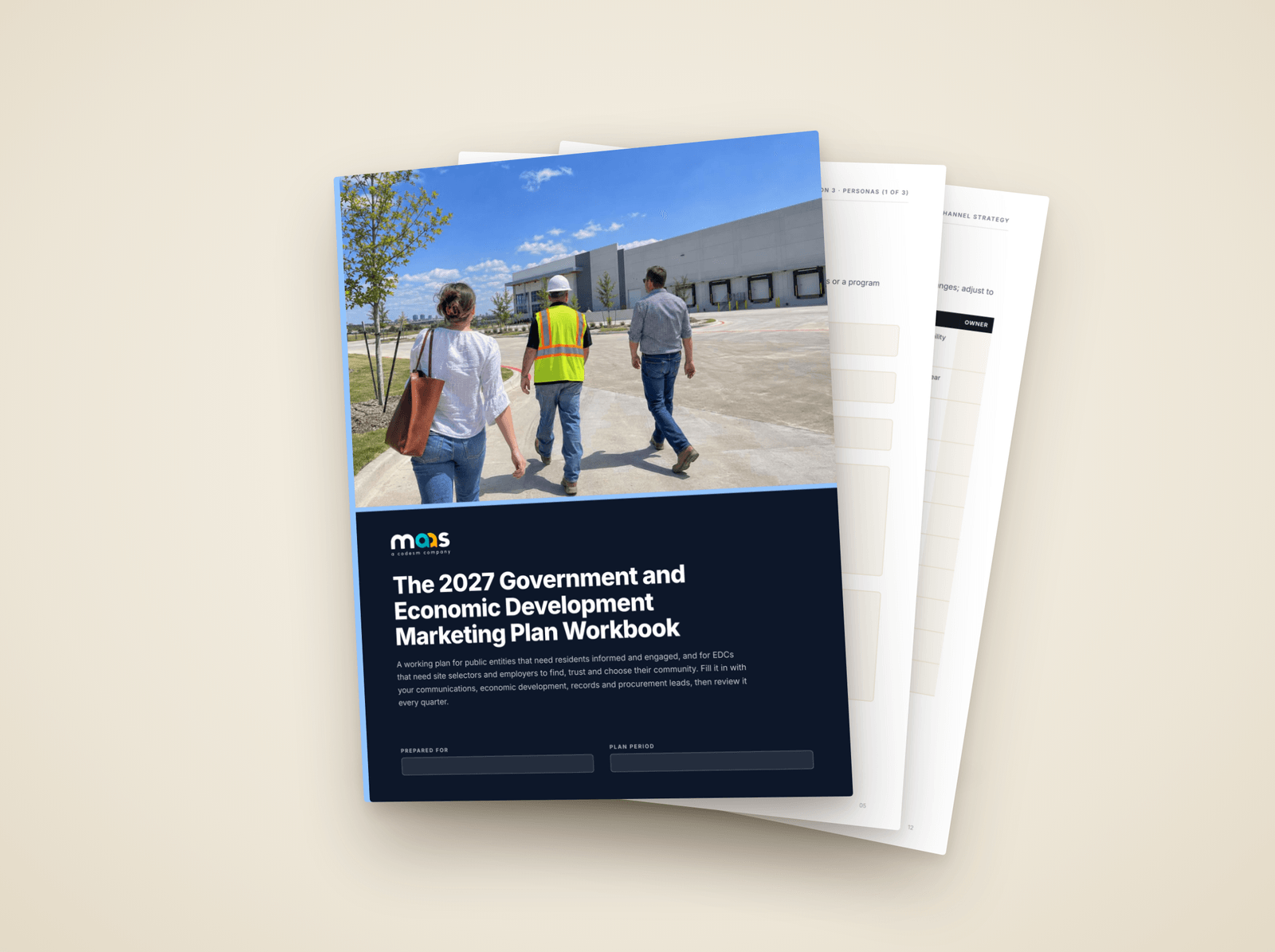
Click to download the free 2027 Government and Economic Development Marketing Plan workbook (PDF)
Why most government and EDC marketing fails
Public agencies don’t lack important information to share. The failures are structural:
- Written for the council, not the resident. Ordinance numbers, agenda language and department names don’t tell anyone what changes on their street or bill.
- The website is a filing cabinet. Services buried three clicks deep, scanned PDFs, agenda packets as the main content. That’s a usability problem now and an accessibility compliance problem soon.
- Social media as a bulletin board. Posts go out, questions go unanswered, and there is no written policy for comments, so staff improvise when a thread turns hostile.
- One language for a multilingual community. Notices go out in English only, and the residents who most need them miss them.
- EDCs sell lifestyle when selectors screen on data. A drone video of downtown doesn’t answer whether a 50-acre site has the power, water and workforce a project needs.
- Outputs instead of outcomes. Reports count posts, press releases and impressions instead of sign-ups, online applications, attendance, prospect inquiries and site visits.
A written plan fixes these by deciding in advance who you need to reach, what you need them to do, which channels reach them, and how you will show results to elected officials and boards.
The 2027 economics of public-sector marketing
Public entities don’t measure revenue. They measure participation, cost to serve and, for EDCs, projects and jobs. These numbers should shape the plan:
Where residents get local news. In the same Pew study, adults preferred television (32%), news websites (26%) and social media (23%) for local news, with print and radio at 9% each. No single channel reaches everyone, so important notices need at least three.
Platform reach. Pew’s 2026 social media data shows 84% of U.S. adults use YouTube and 70% use Facebook. For most communities, those two cover the widest share of residents; Instagram, Nextdoor and LinkedIn are for specific audiences.
Language. The Census Bureau counted 67.8 million people, almost 1 in 5 residents, who spoke a language other than English at home in 2019, and 62% of them spoke Spanish. Check your own community’s American Community Survey data before choosing languages.
Funding constraints. Government entities can’t use Google for Nonprofits, so the free Google Ad Grants budget many nonprofits rely on isn’t available. Federal grant funds can pay for advertising only for specific purposes such as program outreach, and Texas Type A and Type B EDCs may generally spend no more than 10% of corporate revenues on promotional purposes (section 504.105, section 505.103).
What site selectors weigh. In the same 2026 pulse check, 76% of consultants named utility and infrastructure capacity as a factor with the greatest current impact on location decisions, the highest of any factor. Two-thirds (67%) said they had compromised on site or policy factors to meet a client’s timeline, and 69% agreed that community opposition is increasingly a barrier to projects. DCI’s 2026 Winning Strategies in Economic Development Marketing report, its 11th edition, looks at what decision-makers expect from economic development websites and where AI is starting to shape site selection research. The pattern is clear: if your sites, utility capacity and workforce data aren’t easy to find and current, you may be screened out without knowing you were considered.
| Channel | What it is good for | Benchmark or typical cost |
|---|---|---|
| Website | Services, alerts, meetings, EDC site and data pages | Must meet WCAG 2.1 AA by your compliance date |
| Email and SMS alerts | Opt-in updates, emergencies, utility and road notices | Planning range: $3,000–$25,000/year in platform cost, by list size |
| Facebook pages and community groups | Broad resident reach, events, two-way questions | Used by 70% of U.S. adults (Pew); organic is staff time |
| YouTube | Meeting recordings, explainers, site and facility tours | Used by 84% of U.S. adults (Pew) |
| Nextdoor public agency account | Neighborhood-level notices and safety updates | Staff time |
| Local and earned media | Trust, reach with older residents, major announcements | Staff time |
| Paid social and search | Program enrollment, events, recruitment, tourism | Planning range: $1,000–$5,000 per campaign |
| LinkedIn (EDC) | Site selectors, corporate real estate, existing employers | Planning range: $1,500–$5,000/month in paid |
| Site and data platforms (EDC) | Available sites and buildings, workforce and utility data | Planning range: $5,000–$25,000/year in subscriptions |
| Consultant outreach and trade events (EDC) | Relationships with location advisors | Planning range: $5,000–$40,000 per mission or event |
Ranges without a source link are planning ranges, not published benchmarks. Adjust them to your market and procurement rules.
Rules to know before you market
Public communications carries legal obligations private companies don’t have. This is a practical summary, not legal advice: confirm with your attorney, records officer and procurement office.
- ADA Title II web and mobile accessibility. The rule requires WCAG 2.1 Level AA for state and local government websites and mobile apps. An interim final rule in April 2026 moved the compliance dates back a year: April 26, 2027 for entities with a population of 50,000 or more, and April 26, 2028 for smaller entities and special district governments. It covers content provided through contractors and vendors. Exceptions include archived content, older documents nobody uses to access services, posts by members of the public, and social media posts made before the compliance date. The technical standard did not change, and existing ADA duties, such as providing accessible versions on request, apply now.
- Public records and retention. Posts, comments and messages on official accounts can be public records under state law. At the federal level, NARA’s guidance says content on social media is likely a federal record. Follow your state’s retention schedule and use an archiving tool that captures comments and edits, not just your own posts.
- Social media and the First Amendment. In Lindke v. Freed (March 2024), the Supreme Court held that an official’s social media activity is state action only if the official had actual authority to speak for the government on the matter and purported to use it. Official accounts should not block users or delete comments because of viewpoint. Publish a content-neutral comment policy (spam, threats, obscenity, off-topic commercial posts) and apply it consistently.
- Plain language. The Plain Writing Act of 2010 applies to federal agencies, and the federal plain language guidance is a useful standard for anyone. Lead with what changes for the reader, use common words, and keep sentences short.
- Language access. Executive Order 14224 (March 2025) designated English the official language and revoked the federal limited-English-proficiency order, but it states that agencies are not required to stop services in other languages. Statutory duties still apply, such as Section 203 of the Voting Rights Act, which requires covered jurisdictions to provide election materials in specified minority languages. Check state law and the terms of any grants you receive.
- No political advertising with public funds. Most states restrict it. Texas, for example, makes it a Class A misdemeanor for officers or employees of a political subdivision to spend public funds on political advertising, while allowing communications that factually describe a ballot measure without advocating for or against it.
- Procurement and allowable costs. Marketing contracts follow your procurement rules: Texas municipalities, for example, must use competitive procurement above $50,000. On federal awards, advertising “designed solely to promote” the recipient and promotional items are unallowable. Texas EDCs also work within the 10% promotional cap noted above.
- Ad platform categories. Recruitment ads for police, fire, utility crews and other jobs fall under Meta’s employment special ad category, which blocks age, gender and ZIP targeting.
The 10-section government marketing plan framework
The workbook has a fillable page for each section. EDCs and public agencies use the same structure with different inputs.
1. Business snapshot
One page: entity type (city, county, utility, special district, port, EDC), population served (it sets your ADA compliance date), governing body and approval chain, fiscal year and marketing budget line, what you are required to communicate (meetings, rates, elections, emergencies), and the three priorities for the year. EDCs add target industries, available sites and buildings, utility capacity, labor shed and incentives. End with one sentence on why a resident should pay attention or a company should choose you.
2. SWOT analysis
Strengths might be a responsive staff, a strong local news partner, a certified site or a major employer that will vouch for you. Weaknesses: an outdated or inaccessible website, English-only notices, stale site data. Opportunities: a new road, utility upgrade or industrial park, a growing population, reshoring in a target sector. Threats: misinformation in community groups, opposition to development, a neighboring community with ready sites and power.
3. Audience personas
Three personas cover most public entities:
- The Busy Resident. 30 to 55, working, phone-first, and only engaged when something affects them: a road closure, a bill, a permit, a school schedule. Reads Facebook groups and Nextdoor more than the city website. Note the language and access needs in your community, including older and offline residents.
- The Site Selector. A location consultant or corporate real estate executive screening dozens of communities for a client project, usually without contacting them. Needs sites, utility capacity, workforce data and incentives quickly and in a format they can trust.
- The Existing Employer. A local manufacturer, hospital or distributor deciding whether to expand here or elsewhere. Cares about workforce pipelines, permitting speed, infrastructure and whether anyone from the EDC or city visits before there is a problem.
For each, write what triggers their attention, where they look, what they need to do, what blocks them, and what success looks like for both sides.
4. Competitive analysis
Public entities have competitors too. EDCs should compare five peer communities competing for the same projects: shovel-ready acreage, published utility capacity, workforce data on the website, incentive clarity, LinkedIn presence, RFI response time and how quickly the site loads on a phone. Cities and agencies can benchmark peers on services available online, languages offered, alert list size, social response time and accessibility audit results.
5. Brand positioning statement
“For [target audience], [entity] is the [category] that [differentiator] because [reason to believe].”
EDC example: “For manufacturers that need power and workers within two years, Cedar Valley is the I-35 location with 400 acres of industrial land on a substation with available capacity, because the city, utility and EDC finished the site studies before the first prospect called.”
City example: “For Lakeport residents who want answers without calling City Hall, the city’s weekly Lakeport Today text and email is the fastest plain-language source in English and Spanish, because every department publishes to it on the same day.”
6. Goals and KPIs
Three to five SMART goals tied to the outcomes your board or council cares about. Examples:
- Grow opt-in alert subscribers from 4,000 to 12,000 by September 30, 2027
- Raise the online share of permit applications from 40% to 70% by the end of the fiscal year
- Pass a WCAG 2.1 AA audit (automated and manual) on the 50 most-visited pages and all forms before your compliance date
- EDC: generate 24 qualified prospect inquiries and 8 site visits this fiscal year
- EDC: complete 30 business retention visits per quarter and answer every RFI within 48 hours
Each goal gets an owner and a monthly report the board can read in two minutes.
7. Resident and prospect journey map
Two journeys run in parallel.
Resident: a need or event (a storm, a bill, a new program) → search on Google, an AI assistant or a Facebook group → land on a page → understand it in plain language and their own language → act (apply, pay, register, attend) → confirmation → follow-up and feedback → subscribe to updates.
Prospect: a company starts a location search → the consultant builds a long list from state databases, EDC websites and site platforms → short list → RFI → site visit → incentive discussion → decision and announcement → aftercare, where retention and future expansion begin.
Most public entities invest in announcements and miss the screening stages, where the decision to keep looking at you gets made.
8. Channel strategy
| Channel | Role | Cadence | Typical investment |
|---|---|---|---|
| Website and service pages | The source of truth for services, alerts and data | Weekly updates, quarterly audit | Staff time + accessibility tools |
| Email and SMS alerts | Opt-in updates, emergencies, newsletters | Weekly + as needed | $3,000–$25,000/year platform |
| Resident reach, events, questions | 4–6 posts/week + daily monitoring | Staff time + $500–$3,000 per boosted campaign | |
| Nextdoor | Neighborhood notices | 1–3 posts/week | Staff time |
| YouTube | Meetings, explainers, project and site tours | 2–4 videos/month | Staff time + production |
| Earned media | Announcements, projects, trust | Monthly | Staff time |
| Paid social and search | Program enrollment, events, recruitment | Campaign-based | $1,000–$5,000 per campaign |
| LinkedIn (EDC) | Site selectors, executives, employers | 3 posts/week + quarterly paid | $1,500–$5,000/mo paid |
| Site and data platforms (EDC) | Sites, buildings, workforce and utility data | Monthly data refresh | $5,000–$25,000/year |
| Consultant outreach and events (EDC) | Relationships with location advisors | 2–4 missions or events/year | $5,000–$40,000 each |
| Print and utility bill inserts | Offline and older residents | Monthly or quarterly | Print and postage |
All ranges are planning ranges. Scale to your population, budget and procurement thresholds.
9. Content strategy and calendar
A practical mix for a public entity: 40% short video and graphics (explainers, project updates, staff spotlights), 30% service and how-to content that answers the questions your front desk hears most, 20% news and decisions, and 10% community stories. EDCs shift the mix toward data, site and employer stories. Publish every key notice in the languages your community uses, with captions on every video.
Content categories to rotate:
- Service how-tos. “How to pay your water bill online in two minutes.”
- Alerts and preparedness. Weather, outages, road closures, boil notices.
- What was decided. One plain-language post after each council or board meeting.
- Project updates. Construction timelines, before-and-after, what to expect.
- People behind the service. Staff spotlights that double as recruitment.
- Community events. Festivals, markets, workshops, hiring fairs.
- Sites and data (EDC). An available site with acreage, utilities and drive times.
- Employer and workforce stories (EDC). Expansions, training programs, career paths, with the company’s approval.
10. Budget allocation and measurement
A sample $15,000 monthly budget for an EDC:
- Website, site data and accessibility upkeep: $2,500
- LinkedIn and search ads aimed at decision-makers: $3,000
- Content, photography and video: $3,000
- Consultant outreach, trade events and familiarization tours: $3,000
- Earned media and announcements: $1,500
- CRM and email: $500
- Contingency: $1,500
A city communications office might run $8,000 a month: accessibility remediation and website $2,500, alerts platform $400, paid social for programs and events $1,500, video $1,500, translation $1,000, print and inserts $800, contingency $300.
Measurement: report alert subscribers, online versus in-person transactions, call volume on topics you published about, event registrations, accessibility audit results and social response time. EDCs add prospect inquiries, RFIs answered and response time, site visits, business retention and expansion (BRE) visits and announced projects. The workbook includes a dashboard template for board and council reporting.
Common mistakes to avoid
- Treating accessibility as the web vendor’s problem. Contractor content is covered. Put WCAG 2.1 AA in every contract, audit forms and PDFs, and train staff who post.
- Deleting comments or blocking critics. Use a written, content-neutral policy, archive everything and respond with facts.
- Publishing PDFs as the main content. Put the answer on the page and attach the document for those who need it.
- English-only outreach in a multilingual community. Translate the notices that affect money, safety, voting and services first.
- Stale site data. An EDC with last year’s acreage, utility capacity or workforce numbers loses credibility fast. Refresh monthly and date every data page.
- Spending outside the rules. Check procurement thresholds, grant terms, promotional caps and political advertising limits before the campaign, not after.
Where to start if you’re starting from scratch
- Week 1. Sections 1, 3 and 5: snapshot, personas, positioning. Confirm your population and ADA compliance date. Two to three hours.
- Week 2. Run an accessibility audit on your 25 most-visited pages, top forms and mobile app. List the fixes and the vendors responsible.
- Week 3. Adopt a social media and comment policy, set up archiving, and assign response times.
- Week 4. Put an alert sign-up on every page, bill and event. Pick the languages for priority notices.
- Month 2. EDCs: rebuild site and data pages with acreage, utilities, workforce and incentives. Cities: rewrite the 10 most-called-about topics as plain-language pages.
- Month 3. Build the dashboard and a one-page monthly report for the board or council.
- Quarter 2. EDCs: LinkedIn, consultant outreach and BRE visits. Cities: program campaigns timed to the resident calendar.
- Year 1. Review results against goals and write next year’s budget request from the data.
FAQ
What is the role of marketing in economic development? It makes a community findable and credible to the people who decide where projects go, and it keeps existing employers engaged when they decide where to expand. For EDCs, that means accurate site and workforce data, consultant relationships and a steady stream of proof.
What is the difference between an economic development plan and a marketing plan? An economic development plan sets the community’s strategy: target industries, sites, infrastructure and incentives. The marketing plan decides how to communicate that strategy to site selectors, employers and residents, through which channels, with what budget and measured how.
What are effective marketing strategies for government organizations? A plain-language, accessible website built around services, opt-in alerts, an active presence on Facebook and YouTube with a written comment policy, multilingual notices, and reporting tied to outcomes like online transactions and sign-ups.
Can government agencies use Google Ad Grants? No. Google lists governmental entities as ineligible for Google for Nonprofits, which Ad Grants requires.
When do cities and counties have to meet the ADA web accessibility rule? After the April 2026 extension, April 26, 2027 for entities with 50,000 or more people and April 26, 2028 for smaller entities and special districts, under WCAG 2.1 Level AA.
Download the full template
The fillable PDF workbook is the working companion to this guide. Inside:
- How to use the workbook
- Business snapshot
- SWOT analysis
- Three persona templates (Busy Resident, Site Selector, Existing Employer)
- Competitive analysis matrix (5 competitors)
- Brand positioning canvas with a worked example
- Goals and KPI tracker with a monthly check-in
- Customer journey map (10 stages)
- Channel strategy matrix
- Content framework and 30-day content calendar
- Budget allocation worksheet with an example split
- Tech stack checklist and weekly measurement dashboard
- 12-month action plan
- Common mistakes checklist and quick-start plan
Download the 2027 Government and Economic Development Marketing Plan workbook (PDF)
If you’d rather have a team work alongside your staff, from accessible websites and multilingual campaigns to site selector content and board-ready reporting, that is what the government and economic development marketing team at MaaS by CodeSM does for public entities like Edinburg EDC, Pharr EDC and the Port of Brownsville. For how AI assistants now answer questions about your community, see our guide to answer engine optimization. Get in touch and we’ll review where you are and map the plan.
Share this article